



More Than a Single Snapshot
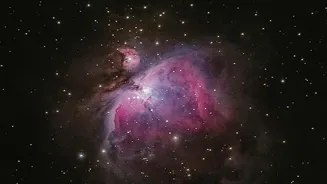
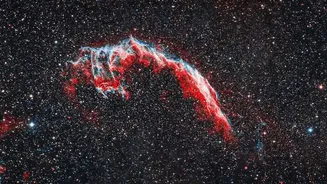
A common misconception about deep-space astrophotography is that the final image is a single, long exposure. In reality, capturing faint objects like nebulae and galaxies, which are millions of light-years away, requires a different approach. Because
of factors like light pollution, atmospheric distortion, and the Earth's rotation, a single long exposure would often result in a blurry, noisy mess. Instead, photographers capture dozens or even hundreds of shorter exposures, typically lasting anywhere from one to ten minutes each. These individual shots, called 'light frames', often look dark and unimpressive on their own. The real magic happens when they are combined in the digital darkroom.
The Power of Stacking
The core technique that specialized software performs is called 'stacking' or 'integration'. Programs like DeepSkyStacker, Siril, or the more advanced PixInsight take all the individual light frames and meticulously align them, so the stars in every image line up perfectly. Once aligned, the software averages the data from all the photos. The principle behind this is simple but powerful: the faint light from the galaxy or nebula (the 'signal') is consistent in every frame, while the random digital noise from the camera sensor is not. As the images are averaged, the random noise cancels itself out, and the consistent signal becomes stronger. This process, known as improving the signal-to-noise ratio, is what allows impossibly faint details to emerge from a dark background.
Cleaning the Image: Calibration Frames
Stacking light frames is only half the battle. To get a truly clean image, photographers must also subtract the inherent flaws and electronic noise produced by their own equipment. This is done using 'calibration frames'. These are special types of images taken to record the unique defects of a camera system. 'Dark frames', for example, are taken with the lens cap on to capture only the camera's thermal noise and hot pixels. 'Flat frames' are taken against a uniformly lit source to map out dust specks on the sensor and vignetting from the lens. 'Bias frames' capture the baseline electronic noise of the sensor itself. The processing software uses these calibration frames to 'subtract' all of this unwanted noise and optical imperfections from the main light frames before stacking, resulting in a much smoother and cleaner foundation to work with.
The Digital Darkroom: Stretching and Enhancing
After stacking and calibration, the result is a 'master' file that contains a huge amount of data, but it still looks very dark and lacks contrast. The final and most artistic step is 'stretching' the data. This doesn't mean resizing the image; it's a process of manipulating the image's histogram to carefully brighten the faint details of the deep-sky object without blowing out the highlights of the stars. This is where the photographer makes crucial decisions about contrast, colour balance, and sharpness. Using tools like curves and levels adjustments, they can tease out the delicate wisps of a nebula or the spiral arms of a galaxy. Software like PixInsight and Adobe Photoshop are powerhouses for this stage, offering intricate control to bring the scientific data to life as a piece of art.