





A Masterclass in High-Speed Navigation
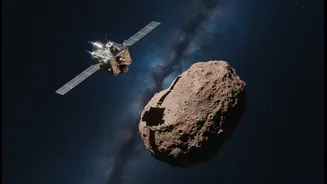
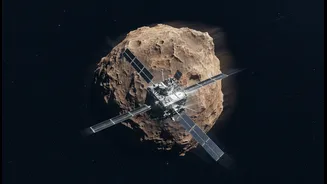
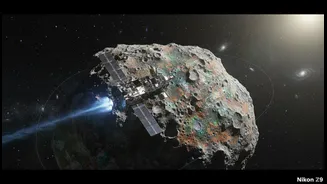
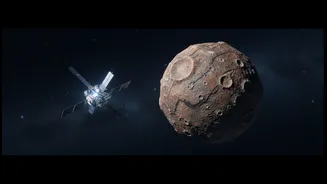
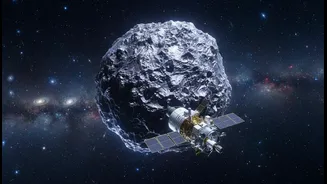
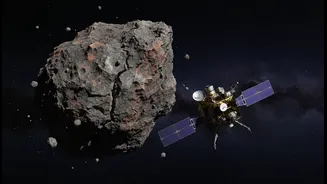
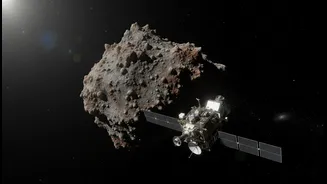
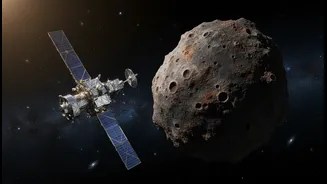
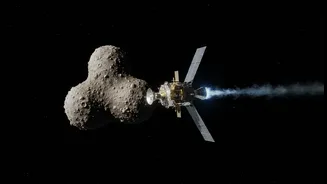
The Torifune flyby was a stunning feat of deep-space navigation. Hayabusa2, which wasn't originally designed for such a fast encounter, hurtled past the asteroid at roughly 5 kilometers per second, or about 18,000 kilometers per hour. JAXA, Japan's space agency,
aimed to get as close as possible without a collision, passing within just 800 meters of the asteroid's center. This maneuver required extraordinary precision. Because of Torifune's small size, the probe could only plot its final trajectory a few days before the encounter, necessitating last-minute orbital adjustments. This successful demonstration of high-precision guidance showcases the advanced capabilities of Hayabusa2's ion engines and autonomous navigation systems, proving their reliability for complex, long-duration missions far from Earth.
New Science from an S-Type Asteroid
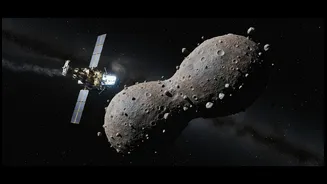
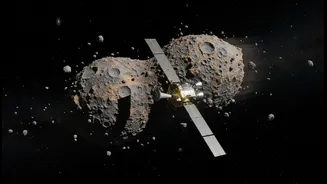
The flyby has already yielded fascinating scientific discoveries. Images beamed back to Earth revealed that Torifune, previously known as 2001 CC21, is a 'contact binary'—essentially two separate asteroids that collided at low speed and stuck together, forming a peanut-like shape. This provides a rare, close-up look at how small bodies in the solar system might grow into larger objects. While Hayabusa2's first target, Ryugu, was a carbonaceous 'C-type' asteroid rich in water and organic molecules, Torifune is a stony 'S-type' asteroid, primarily composed of silicate minerals like olivine and pyroxene. Studying this different class of asteroid helps scientists understand the diversity of materials in our solar system and the processes that shaped the planets. Data from the spacecraft's infrared spectrometer and other instruments will continue to be analyzed, promising more revelations about Torifune's composition and history.
A Testbed for Planetary Defense
Beyond pure science, the Torifune flyby serves as a crucial test for planetary defense technologies. An asteroid the size of Torifune is projected to collide with Earth every 100 to 1,000 years, capable of causing significant damage. The ability to rapidly intercept and characterize a potentially hazardous object is a vital skill. JAXA viewed this mission as an opportunity to test the kind of high-speed maneuvering that would be necessary for a 'kinetic impactor' mission, where a spacecraft is deliberately crashed into an asteroid to alter its course. The successful flyby proves that we can get a probe close enough to a fast-moving target to gather essential data on its size, shape, and structure—information needed to plan a deflection mission. This real-world test provides invaluable experience that complements missions like NASA's DART, which successfully demonstrated a kinetic impact in 2022.
The Journey Continues
Hayabusa2's work is far from over. Having successfully completed this intermediate challenge, the resilient spacecraft is now continuing its decade-long extended mission. Using its remaining xenon fuel, it will perform two gravity-assist flybys of Earth in 2027 and 2028 to set its course for an even more ambitious target. In July 2031, it is scheduled to rendezvous with 1998 KY26, an extremely small and rapidly rotating asteroid just 11 meters in diameter. This would make it the smallest asteroid ever visited by a spacecraft. The Torifune encounter was a critical stepping stone, validating the technology and strategies needed to approach this challenging final target. Each phase of Hayabusa2's journey expands humanity's ability to explore and interact with the small bodies that populate our cosmic neighborhood.