





The Doctor Who Reaches for the Stars
Anil Menon is not a typical astronaut, if such a thing exists. Born in Minnesota to Indian and Ukrainian immigrants, his resume is a powerful blend of medicine and aviation. He is a lieutenant colonel in the U.S. Air Force, an actively practicing emergency
medicine physician, and was SpaceX's first-ever flight surgeon, where he helped launch the first private crew into orbit. Before being selected as a NASA astronaut in 2021, he served as a crew flight surgeon for several long-duration missions on the ISS, supporting astronauts from the ground. His experience isn't limited to pristine labs; he has been a first responder in disaster zones like the 2010 Haiti earthquake and has treated climbers on Mount Everest. This unique combination of emergency, wilderness, and aerospace medicine makes him exceptionally qualified to handle the medical challenges of space.
The Human Body: A Final Frontier
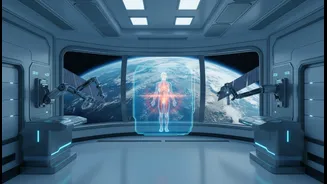
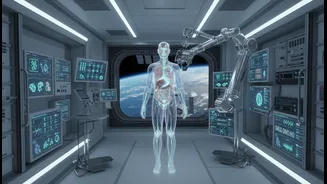
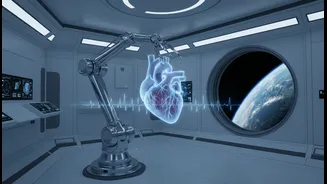
Space is an unforgiving environment. Without Earth's gravity, the human body begins to change in strange and often detrimental ways. Astronauts experience a cascade of physiological shifts, including muscle atrophy and significant bone density loss, at a rate of 1-2% per month. Fluids shift upwards, leading to the characteristic “puffy face” and putting pressure on the eyes, a condition known as Space-Associated Neuro-ocular Syndrome (SANS) that can affect vision. The cardiovascular system gets deconditioned as it doesn't have to work as hard, and the immune system can weaken, potentially reactivating dormant viruses. These effects are manageable on shorter ISS missions, but they pose serious questions for the future of long-duration spaceflight.
New Questions for a New Era of Exploration
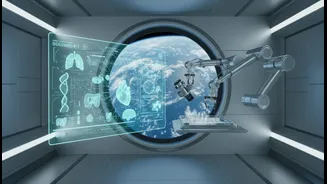
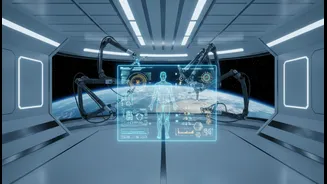
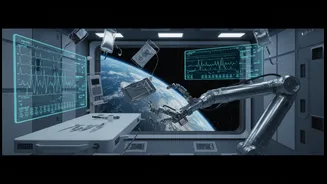
The "new questions" Menon's mission brings into focus aren't about his capabilities but about the next giant leap: missions to the Moon and Mars under the Artemis program. A trip to Mars could take years, and there is no coming home early for a medical emergency. Astronauts must be prepared for complete medical autonomy. The biggest challenges include the constant exposure to deep-space galactic cosmic radiation, which dramatically increases cancer risk, and the profound psychological strain of extreme isolation. Furthermore, how do you perform a complex medical procedure in zero gravity? How do you ensure medications remain stable for years? Researchers are exploring everything from developing new shielding technologies to testing compact medical devices and even using AI to help diagnose illnesses without ground support.
An Orbiting Laboratory for Earth and Beyond
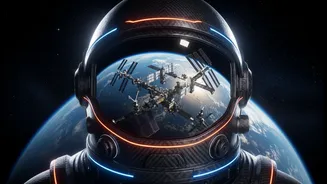
Menon’s eight-month mission aboard the ISS will involve critical research. He is slated to conduct experiments on how microgravity impacts blood flow and composition, and test technologies for manufacturing medical supplies like IV fluids from the station’s water supply. Physician-astronauts are invaluable because they can provide real-time, expert feedback on experiments and respond to medical issues. The research conducted on the ISS doesn't just benefit future astronauts. Studying accelerated bone loss in space helps researchers on Earth better understand osteoporosis. Similarly, understanding how the cardiovascular system adapts to microgravity provides insights into conditions faced by bedridden patients. The ISS is a unique laboratory where the extremes of space can unlock medical breakthroughs for all of humanity.