





Not All UV Rays Go on Holiday
The sun emits two main types of ultraviolet (UV) radiation that reach our skin: UVA and UVB. Think of UVB as the 'burning' rays; they are more intense during summer, cause sunburn, and are a primary driver of skin cancer. As the weather cools, the intensity
of these UVB rays decreases. This is why you're far less likely to get a painful sunburn on a cool October day. However, UVA rays are a different story. Known as the 'aging' rays, they maintain a consistent intensity throughout the entire year, regardless of the temperature or season. They are also more plentiful, with research showing that UVA levels in ambient light can be 10 to 100 times higher than UVB.
The Silent Damage of UVA Rays
Because you don't feel the immediate burn from UVA rays, their damage can go unnoticed for years. These longer-wavelength rays penetrate deeper into the skin than UVB rays, reaching the dermis layer. This is where they wreak havoc on your skin's structural integrity, breaking down collagen and elastin. This long-term exposure is a direct cause of what's known as photoaging: wrinkles, fine lines, leathery texture, and sunspots. More alarmingly, this deep DNA damage is also linked to the development of several types of skin cancer. So while you might not be getting a sunburn in cooler weather, the invisible damage that accelerates aging and increases cancer risk continues unabated.
Understanding 'Broad-Spectrum' Protection
This is where the term 'broad-spectrum' on your sunscreen bottle becomes critically important. A product labeled as broad-spectrum has been formulated and tested to protect you from both UVA and UVB rays. If a sunscreen only lists an SPF (Sun Protection Factor) number without this designation, it primarily protects against UVB rays—the ones that cause burning. For true year-round protection against both premature aging and skin cancer, choosing a broad-spectrum formula is non-negotiable. Dermatologists recommend a broad-spectrum sunscreen with an SPF of 30 or higher for daily use.
Debunking Cool-Weather Sun Myths
Several common myths contribute to people skipping sunscreen in the autumn and winter. The first is that cloud cover is enough protection. While thick clouds can filter some UV radiation, thin or scattered clouds do very little, allowing the majority of rays to pass through. In fact, a phenomenon known as 'cloud enhancement' can occur on partly cloudy days, where UV rays reflect off the edges of clouds, actually increasing your total exposure. Another major factor is reflective surfaces. Snow and ice can reflect up to 80% of UV radiation, meaning you get hit by the rays from above and below. This is why skiers and snowboarders can get severe sunburns despite the cold temperatures. Even driving can be a source of exposure, as UVA rays can penetrate glass.
Your Year-Round Sunscreen Strategy
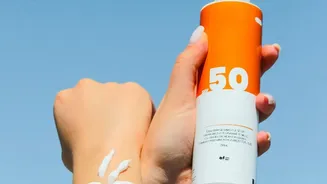
Integrating sunscreen into your daily routine is the most effective way to ensure consistent protection. Think of it not as a special step for a beach day, but as a fundamental part of your morning skincare, just like brushing your teeth. For daily use, experts suggest applying a broad-spectrum sunscreen with at least SPF 30 to all exposed skin about 15 minutes before heading outside. This includes often-forgotten areas like your ears, the back of your neck, and your hands. If you find traditional sunscreens too heavy for daily wear, explore modern formulas like serums, gels, or lightweight lotions designed for the face. Remember to reapply every two hours if you're outdoors for an extended period, or more frequently if you've been sweating.