

Taler Bora from Bengal
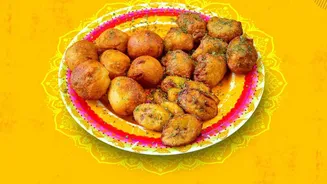
In Bengal, the arrival of Janmashtami coincides with the season of the sugar palm fruit, or 'Tal'. This happy coincidence gives rise to Taler Bora, a delectable deep-fried fritter that is a cornerstone of the festival's offerings. The process involves
extracting the aromatic, sweet pulp from the ripe palm fruit and mixing it with rice flour, coconut, and jaggery or sugar to form a thick batter. Spoonfuls of this batter are then fried in ghee or oil until they turn a deep golden brown, resulting in a treat that is crispy on the outside and soft and fragrant on the inside. Believed to be a favourite of Lord Krishna, these seasonal sweets perfectly capture the essence of monsoon festivities in the east.
Gopalkala from Maharashtra
Moving west to Maharashtra, we find a unique savoury preparation called Gopalkala. This dish is intrinsically linked to the playful tradition of Dahi Handi. Gopalkala is a no-cook dish, a simple yet flavourful mix of flattened rice (poha), yoghurt, chopped cucumber, fresh coconut, and sometimes pomegranate seeds and peanuts. It is tempered with ghee, cumin seeds, and green chillies. The story behind it is that Lord Krishna would mix the food brought by his cowherd friends into one single dish, which they would all share. Gopalkala symbolises this spirit of community and shared joy, a cool and refreshing prasad that offers a delightful contrast to the richer sweets.
Vella and Uppu Seedai from Tamil Nadu
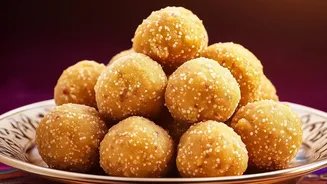
Travel south to Tamil Nadu, and the sound of Janmashtami, or Krishna Jayanthi, is often accompanied by the crunch of Seedai. These are tiny, ball-shaped fritters made from rice flour, offered in two distinct varieties: Vella Seedai (sweet) and Uppu Seedai (salty). Uppu Seedai is savoury, seasoned with butter, salt, and spices like asafoetida. Its sweet counterpart, Vella Seedai, incorporates jaggery and coconut into the rice flour dough, creating a delightful balance of flavours. Preparing these tiny, perfectly round balls requires care and patience, making the offering a true labour of love that is central to South Indian celebrations of the festival.
Makhana Paag from North India
While makhana (fox nuts) are a common fasting food, Makhana Paag is a special sweet preparation popular in the Braj region of Uttar Pradesh and Bihar. This dish involves roasting the light, airy makhana in ghee until they are perfectly crisp. A sugar syrup is cooked to the right consistency, and the roasted makhana are folded in, along with flavourings like cardamom and chopped nuts. The mixture is then spread onto a plate and allowed to set, after which it's cut into brittle-like pieces. The result is a crunchy, sweet confection that is offered as bhog and enjoyed for days after the festival, a tribute to Krishna's heartland.
Vella Aval from Karnataka
Poha, or flattened rice, makes another appearance, this time in a sweet southern form known as Vella Aval or Sweet Poha. This dish holds a special significance, echoing the story of Krishna and his humble friend, Sudama. According to the tale, Sudama brought a small pouch of flattened rice as a gift for Krishna, an offering made with pure devotion. Vella Aval is a simple preparation where poha is gently mixed with grated jaggery, fresh coconut, and a hint of cardamom. It is a quick, no-cook prasad that is popular in Karnataka and other parts of South India, serving as a powerful reminder that the simplest offerings made with love are the most profound.