





Sailing on a Beam of Light
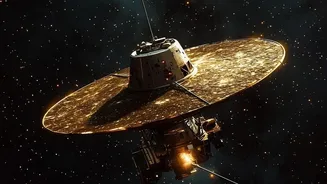
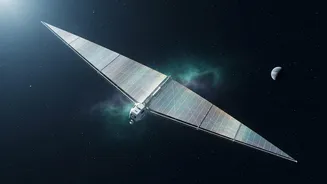
At its core, a solar sail works much like a sailboat catching the wind. Instead of wind, however, it catches sunlight. Sunlight is made up of tiny particles called photons. While photons have no mass, they do have momentum. When billions of these photons bounce
off a large, reflective surface, they transfer their momentum, creating a tiny but continuous push. In the vacuum of space, this constant, gentle thrust adds up. Although the acceleration is slow at first—sometimes compared to the gentle push of an office lift—it is unending as long as the sail is exposed to light. Over weeks and months, a solar sail-powered craft can build up tremendous speeds, potentially far greater than a conventional rocket could achieve after its initial burn is over.
The Advantage of Going Fuel-Free
The single biggest challenge for deep-space missions is fuel. A significant portion of a traditional spacecraft's launch weight is dedicated to the propellant it needs for its journey. This not only makes missions expensive to launch but also fundamentally limits their duration and reach. Once the fuel is gone, the spacecraft can only coast, relying on complex and time-consuming gravity-assist manoeuvres around planets to change course. Solar sails completely sidestep this problem. By using sunlight, they have a virtually limitless source of propulsion. This means missions are no longer constrained by how much fuel they can carry, opening up possibilities for long-duration journeys to the outer planets and even interstellar space. Because they don't need propellant, these spacecraft can be lighter, cheaper to launch, and have longer operational lifetimes.
Why 'Ultra-Thin' Is a Game-Changer
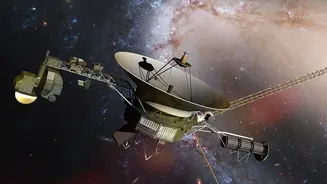
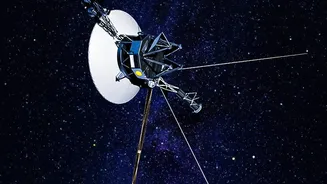
For a solar sail to be effective, it needs to be incredibly large to catch enough photons, but also extremely lightweight to be pushed by them. This is where modern materials science comes in. Recent advancements are focused on ultra-thin films, some even exploring materials as thin as a single atom, like graphene. NASA's Advanced Composite Solar Sail System (ACS3), launched in 2024, is testing new composite booms that are 75% lighter than previous metallic versions, allowing for larger sails to be packed into tiny satellites called CubeSats. The goal is to create sails spanning hundreds or even thousands of square metres while being light enough to be effectively accelerated by sunlight. These ultra-lightweight designs are crucial for achieving the high speeds needed for ambitious missions, such as exploring the Kuiper Belt or reaching interstellar space in a fraction of the time it took probes like Voyager.
From Theory to Reality
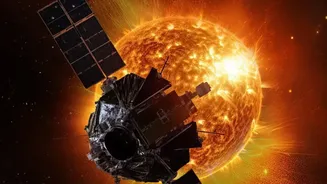
Solar sailing is no longer just a theoretical concept. Japan's IKAROS mission successfully demonstrated the technology in 2010 with a fly-by of Venus. The Planetary Society's LightSail 2 mission, which operated from 2019 to 2022, proved that a small satellite could use a solar sail to actively change its orbit around Earth. Building on these successes, several new missions are underway. NASA's ACS3 is a current technology demonstrator in low-Earth orbit. Looking ahead, concepts like the Solar Cruiser, equipped with a massive 1,653-square-metre sail, are being developed to provide earlier warnings for space weather by positioning observatories closer to the Sun. These missions are critical stepping stones, proving the viability of the technology for more complex applications, from asteroid mining return missions to fast transit probes to the outer solar system.