



The Cosmic Data Traffic Jam
Since the dawn of the space age, missions have relied on radio frequency (RF) communications to send priceless data back to Earth. From the first grainy images of Mars to complex scientific readings, radio waves have been the workhorse of interplanetary
dialogue. However, this trusted technology is reaching its physical limit. As our scientific instruments become more sophisticated, capturing vast amounts of high-resolution data, RF systems are struggling to keep up. Transmitting a complete, detailed map of Mars using current radio technology could take as long as nine weeks. This frustratingly slow speed creates a significant bottleneck, delaying discoveries and limiting the type of information, like live high-definition video, that future missions can send home.
A Leap into Light Speed
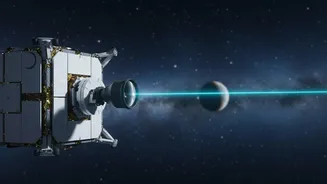
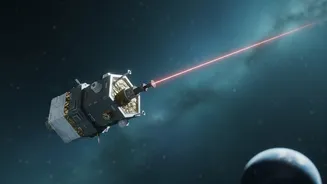
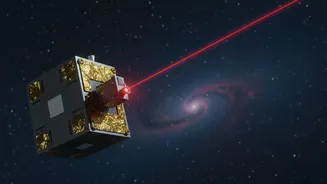
The solution is a monumental leap from radio waves to light itself. NASA is pioneering Deep Space Optical Communications (DSOC), a system that uses near-infrared lasers to transmit information. This is less like science fiction and more like an evolution of the fibre optic technology that powers high-speed internet on Earth. Instead of sending broad radio signals that spread out over vast distances, DSOC uses a tightly focused beam of light. The key difference lies in the frequency of the waves. Infrared light has a much higher frequency than radio waves, which allows it to carry significantly more data in each transmission. This jump is not just an incremental improvement; it promises to increase data rates by 10 to 100 times compared to the state-of-the-art radio systems used today.
NASA's Psyche Mission Puts it to the Test
This revolutionary technology is not just theoretical; it's already being proven in the void of space. The DSOC experiment is a technology demonstration hitching a ride on NASA's Psyche spacecraft, which launched in October 2023 on a journey to a unique metal-rich asteroid. The two-year demonstration has already smashed expectations. In a landmark test, DSOC streamed the first ultra-high-definition video from deep space, sending it from 19 million miles away at a blistering 267 megabits per second (Mbps). More recently, during Psyche's flyby of Mars in May 2026, the system successfully transmitted data from over 140 million miles away. These tests prove that stable, high-bandwidth laser links can be maintained across the immense distances required for missions to Mars and beyond.
The Future is in High Definition
The success of infrared light communications opens up a new era of space exploration. With data transmission capabilities comparable to terrestrial broadband internet, we can finally overcome the cosmic traffic jam. Future crewed missions to Mars, for instance, could stream live 4K video, allowing for real-time collaboration with scientists on Earth and sharing the experience with the public in unprecedented detail. Robotic explorers could send back massive datasets from high-resolution instruments, accelerating the pace of scientific discovery. Sending a full map of Mars could be reduced from nine weeks to just nine days. Furthermore, optical communication systems are smaller, lighter, and require less power than their radio counterparts, freeing up precious mass and energy for more science instruments on spacecraft. The beams are also more secure, as their narrow focus makes them difficult to intercept.