



A Mission of Mixed Fortunes
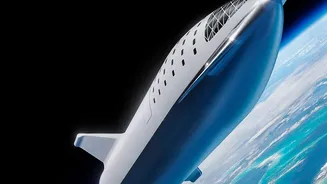
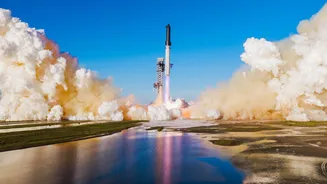
SpaceX's 15th Starship test flight, which lifted off from Starbase, Texas, on November 13, was designed to be the most ambitious yet. The primary goal was to demonstrate full reusability by recovering both the Super Heavy booster and the Starship upper
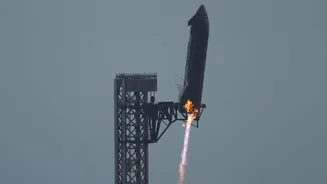
stage using the launch tower's mechanical arms, nicknamed 'Mechazilla'. This 'double catch' has been described as the holy grail for creating a rapidly reusable rocket system, a key part of the company's long-term vision. While the mission ultimately fell short of that complete objective, it delivered a breakthrough that could fundamentally alter the economics of space travel. After a 22.5-hour journey that included 14 orbits of Earth and the deployment of 26 Starlink satellites, the Starship upper stage made a triumphant, controlled return.
The Setback: What Happened to the Booster?
The setback occurred shortly after launch. The Super Heavy booster, a colossal first stage powered by 33 Raptor engines, performed its duty of pushing the Starship spacecraft toward orbit before separating as planned. It then began its own descent, with the intention of being caught by the Mechazilla arms. However, an issue during its return burn led to an automatic abort of the catch attempt. SpaceX reported that a low fuel mass alarm was triggered, causing the booster's guidance system to divert it to a safe splashdown in the Gulf of Mexico, where it was destroyed. While the loss of the booster marks a failure in the mission's secondary objective, SpaceX has successfully recovered boosters on three previous Starship flights, suggesting this is a solvable engineering challenge.
The Triumph: A Perfect Catch
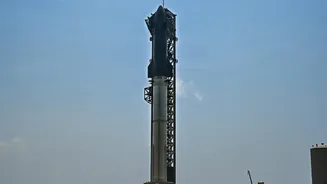
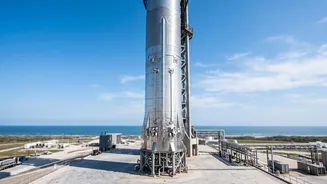
The true headline of the event was the flawless recovery of the Starship upper stage. Never before had an orbital-class upper stage been caught after returning from space. On November 14, after surviving the fiery heat of atmospheric reentry, the vehicle precisely navigated itself to the launch tower. It then fired its engines for a final landing burn, slowing its descent and allowing the huge 'chopstick' arms of the tower to close around it, securing the vehicle high above the ground. The stunning manoeuvre, which SpaceX live-streamed, was hailed as a historic feat of engineering. One company commentator emotionally declared, 'We caught a Starship, and now everything changes'.
Why Catching the Upper Stage Is a Game-Changer
Recovering a first-stage booster is an achievement SpaceX mastered years ago with its Falcon 9 rocket. Recovering the upper stage, however, is a much harder problem. This part of the rocket travels to orbital velocity, meaning it endures far greater speeds and temperatures upon reentry. Most rocket systems treat the upper stage as disposable for this very reason. Successfully catching the Starship proves that both major components of the launch system can be brought back for reuse. This is the crucial missing piece for achieving a fully and rapidly reusable system, which has the potential to drastically lower the cost of accessing space and increase the frequency of launches. Being able to inspect the returned vehicle will provide invaluable data on the performance of its heat shield and other systems, accelerating future development.