





Why Your Breath Matters
When starting a new exercise, we often focus so intensely on getting the movement right that we forget something fundamental: breathing. Many beginners either hold their breath or breathe erratically. However, mastering your breath is crucial for several
reasons. Coordinated breathing engages your core, providing stability to your spine and pelvis. This creates a solid foundation, allowing your chest, shoulders, and arms to generate more force safely. A steady supply of oxygen to your muscles improves endurance and efficiency, helping you perform more reps with better form. It also has a calming effect, keeping you in control of the movement rather than rushing through it. Ultimately, linking your breath to the exercise turns a simple motion into a more powerful and mindful practice.
Setting Up Your Wall Push-Up
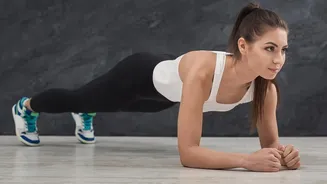
Before we sync the breathing, let's establish the correct form. All you need is a clear, solid wall. Stand about an arm's length away, facing it, with your feet shoulder-width apart. Place your palms flat on the wall, slightly wider than your shoulders and at about chest or shoulder height. Your body should form a straight, rigid line from your head to your heels, like a plank. Engage your core by gently bracing your abdominal muscles and squeezing your glutes to prevent your hips from sagging. This 'plank' position is the foundation of a good push-up, whether on the wall or the floor. Your head should remain in a neutral position, in line with your spine, not dropping forward.
The Correct Breathing Rhythm
The golden rule for breathing during most strength exercises is simple: exhale on the effort, inhale on the easier part. For a push-up, the 'effort' is pushing yourself back to the start. The movement has two phases: the eccentric (lowering your body) and the concentric (pushing back up). Inhale through your nose as you bend your elbows and lower your chest toward the wall. This should be a slow, controlled movement. Then, exhale through your mouth as you press against the wall to straighten your arms and return to the starting position. Think of it as: inhale down, exhale up. This rhythm ensures your muscles get oxygen when they're lengthening and allows you to use the force of your exhale to power the push.
Common Mistakes to Avoid
As a beginner, it's easy to fall into a few common traps. The most frequent is holding your breath. This can increase blood pressure and make you feel dizzy. Another is 'reverse breathing'—exhaling on the way down and inhaling on the way up. This makes the push phase feel weaker and less stable. Also, watch out for shallow chest breathing. Aim for deeper breaths that feel like they are coming from your belly. Finally, avoid flaring your elbows straight out to the sides. This puts unnecessary stress on your shoulder joints. Instead, let your elbows track back at a roughly 45-degree angle from your body.
Putting It All Together
Now, let's combine form and breath. Stand at the wall in your starting plank position. Take a moment to feel stable. Begin to inhale slowly as you bend your arms, lowering your entire body as one unit toward the wall. Keep your back straight and your core tight. Go as low as you can comfortably. As soon as your chest gets close to the wall, begin to exhale and push forcefully back to the start. The exhale should match the duration of the push. Don't rush it. The goal is a smooth, controlled motion where the breath paces the movement. If you find it difficult, try doing just a few perfect repetitions, focusing only on the rhythm, rather than trying to do as many as possible.