
A Groundbreaking Observation
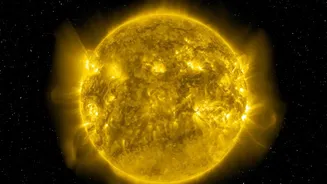
Using the powerful Daniel K. Inouye Solar Telescope in Hawaii, scientists have obtained the highest-resolution images in history of the Sun's visible surface, known as the photosphere. These remarkable images show small, swirling vortices of plasma, each
only a few dozen kilometres wide, dancing at the edges of larger, bubble-like structures called granules. While scientists had long theorized their existence, this is the first time these phenomena, known as Kelvin-Helmholtz instabilities, have been directly and clearly observed on the Sun. It's an achievement likened to spotting a small coin from over 100 kilometres away, providing an unprecedented window into the turbulent nature of our star.
What Are These 'Solar Whirlpools'?
Imagine two streams of fluid moving past each other at different speeds. At the boundary, you often get waves and eddies. This is the essence of a Kelvin-Helmholtz instability, a process we see in Earth's clouds and oceans. On the Sun, this occurs when streams of super-heated plasma flow past each other. These newly seen vortices are incredibly dynamic, swirling at the edges of the Sun's giant convection cells, which are themselves the size of large countries. Unlike the giant, globe-spanning waves known as solar tsunamis, these newly viewed waves are much smaller, yet they appear to be a constant, fundamental feature of the solar surface. Their discovery demonstrates how even minute processes can profoundly shape the character of our star.
Solving a Burning Mystery
One of the longest-standing puzzles in solar physics is why the Sun's outer atmosphere, the corona, is hundreds of times hotter than its surface. The photosphere simmers at around 5,500 degrees Celsius, while the corona blazes at over a million degrees. These new observations offer a vital clue. Scientists believe these small, persistent plasma vortices could act like mixers, twisting the Sun's magnetic field lines. This twisting builds up enormous amounts of energy, similar to a coiled spring. The vortices may be the mechanism that constantly stirs the pot, transferring vast quantities of energy from the surface up into the corona, helping to heat it to its extreme temperatures.
A Clearer Forecast for Space Weather
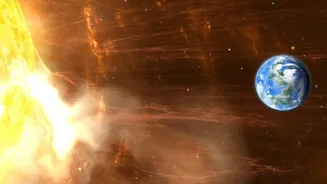
Beyond solving academic mysteries, this discovery has profound practical implications for us on Earth. The same twisting and snapping of magnetic field lines that heats the corona is also what powers solar flares and coronal mass ejections (CMEs). These powerful eruptions of plasma and radiation can hurtle towards Earth, creating 'space weather' that threatens our satellites, communication networks, and even power grids. By observing these small-scale vortices, scientists can better understand the fundamental build-up of magnetic energy that leads to these major events. In the future, tracking these swirls could become a key part of forecasting dangerous solar storms long before they erupt, giving us more time to prepare and protect our vital infrastructure.