


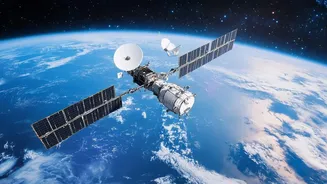
The Constant Drag of Low-Earth Orbit
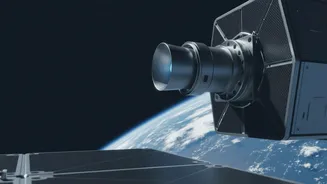
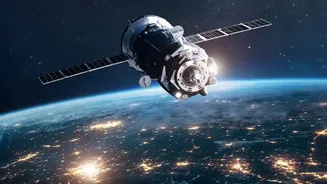
Low-Earth Orbit, or LEO, is the region of space from about 160 to 1,000 kilometres up. It's prime real estate for satellites that provide us with everything from high-resolution Earth imagery to low-latency internet. But there’s a catch. This region isn't
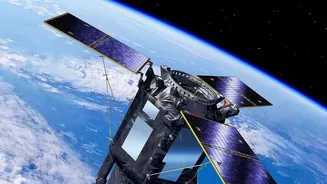
a perfect vacuum. There are still wisps of atmosphere, and for a satellite moving at over 28,000 kilometres per hour, colliding with these sparse air molecules creates significant drag. This drag causes the satellite's orbit to decay, pulling it closer to Earth. To survive, satellites must fire onboard thrusters to give themselves a boost and maintain their altitude. This requires propellant, typically a heavy and expensive gas like xenon. But propellant is finite. Once a satellite runs out of fuel, its mission is over. It becomes another piece of space junk until it eventually burns up in the atmosphere. The European Space Agency's GOCE satellite, for instance, performed incredible science from an orbit of just 250 km but was limited by the 40 kg of xenon it carried. This fundamental limitation has capped the potential of LEO missions for decades.
A Jet Engine for the Edge of Space?
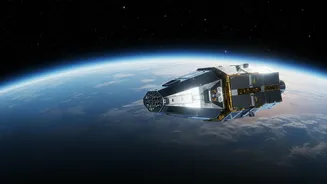
Enter the air-breathing electric thruster, a technology that sounds like it’s straight out of science fiction. The concept is elegantly simple: instead of carrying fuel, why not use the very air that causes the drag? These systems, also known as Air-Breathing Electric Propulsion (ABEP), are designed with a special intake to scoop up the residual atmospheric particles. Once collected, these molecules—mostly nitrogen and oxygen—are channelled into an electric thruster. Inside, they are ionized (given an electric charge) and then accelerated by powerful electric fields, shooting them out at extremely high velocity. This expulsion generates thrust, counteracting the atmospheric drag. It functions a bit like a jet engine, which sucks in air to create thrust, but it’s designed for the near-vacuum of space and is powered by electricity, usually from solar panels. This process would ideally allow a satellite to compensate for drag continuously, enabling it to stay in orbit for as long as its electronic components continue to function.
The Advantages of 'Infinite' Fuel
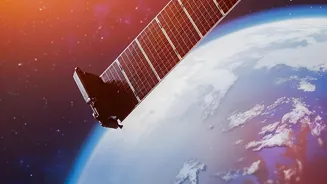
The implications of this technology are profound. First and foremost is the potential for near-limitless mission duration. With an unending supply of propellant, satellites could operate for years or even decades longer than current designs allow. This dramatically improves the return on investment for any given mission. Secondly, it opens up the possibility of operating in Very Low-Earth Orbit (VLEO), at altitudes below 400 km. Flying closer to Earth offers huge benefits, including higher-resolution images for observation satellites and lower latency for communication constellations. Furthermore, ABEP systems contribute to a more sustainable space environment. Because satellites no longer need large, heavy tanks of propellant, launch costs could be significantly reduced. More importantly, the problem of space debris is mitigated. ABEP-equipped satellites can maintain their orbits precisely and, at the end of their operational lives, use the natural atmospheric drag to deorbit and burn up cleanly, leaving no trace behind.
From Theory to Reality
While the idea has been around since the 1960s, turning it into a working reality has been a major engineering challenge. The main hurdles include designing an intake that can efficiently collect enough sparse air molecules without creating excessive drag itself, and developing a thruster that can effectively ionize and accelerate atmospheric gases, which are harder to work with than traditional xenon. Despite these difficulties, progress is accelerating. In 2018, the European Space Agency (ESA) announced the world's-first successful ground test of a complete air-breathing thruster system, proving the concept was viable. In tests, they saw the thruster's blue xenon plume turn purple as it began using an air mixture, a landmark achievement. Since then, research projects like BREATHE and AETHER, funded by the EU and involving companies like Sitael and TransMIT IQM, have continued to refine the technology. They are tackling challenges like material erosion from reactive oxygen and optimizing thruster efficiency to pave the way for the first in-orbit demonstrations.