


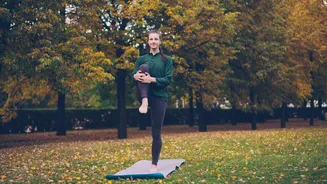
The Foundation: Classic Tree Pose
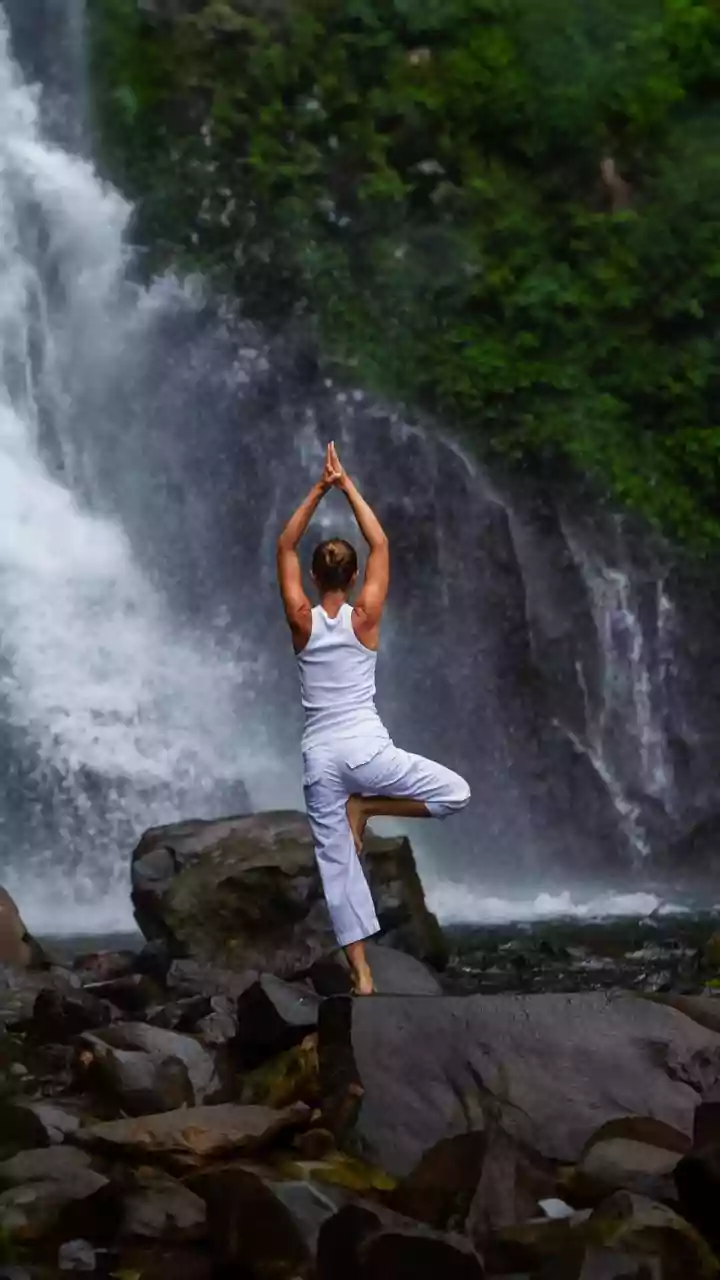
Before branching out, solidify your roots. Begin in Mountain Pose (Tadasana), standing tall with your weight evenly distributed. Shift your weight onto one foot, engaging the muscles of the standing leg. Place the sole of your other foot on your inner
ankle, calf, or upper thigh, avoiding the knee joint. Press the foot and standing leg against each other to create a stable connection. Bringing hands to your heart or raising them overhead challenges your balance from the start. Your core instinctively fires to keep your torso upright, while the small muscles in your standing foot and ankle work constantly to make micro-adjustments, building foundational strength. Focus your gaze on a fixed point (drishti) to aid your balance.
For Stability Seekers: Kickstand Variation
If you feel particularly wobbly, the kickstand or low-branch variation is your best friend. In this modification, you rest the toes of your lifted foot on the mat, with your heel pressed against your standing ankle. This provides an extra point of contact with the ground, significantly reducing the balance challenge. The benefit here is that it allows you to focus purely on the alignment and muscular engagement without the fear of falling. You can consciously work on keeping your hips level and firing up your standing leg's glutes and quadriceps. This builds muscle memory and ankle strength more safely, preparing you for lifting the foot entirely when you feel ready.
Challenge the Core: Arms Overhead and Swaying
A simple change in your arms can dramatically increase the demand on your core. From a stable Tree Pose, inhale and extend both arms straight overhead. This raises your body's center of gravity, forcing your abdominal muscles to work harder to prevent you from tipping over. For a further challenge, you can introduce gentle movement, sometimes called 'Windy Tree'. Slowly sway your arms and upper body from side to side. This controlled movement constantly shifts your center of gravity, requiring your core, especially the obliques, and your standing ankle to react and stabilize you through unpredictable motion.
For Deeper Hip Opening: Half-Lotus Tree
The Half-Lotus variation (Ardha Padma Vrksasana) introduces a deeper hip-opening element while seriously testing your stability. Instead of placing your foot on the inner thigh, you carefully guide the top of the lifted foot to rest on the opposite hip crease, with the sole of the foot facing upward. This requires significant flexibility in the hip, knee, and ankle. The asymmetrical position challenges your core to maintain square hips and an upright spine. Your standing ankle, meanwhile, has to work overtime to manage the unique distribution of weight and maintain its grounding, strengthening the joint from all angles.
Integrate the Side Body: Bending Tree Pose
To specifically target your obliques and the side waist, add a lateral bend. Once stable in your Tree Pose with one arm reaching up, begin to lean toward the side of the bent knee. You can rest your other forearm on the lifted thigh for support. This side bend, or 'Bending Tree', directly engages the muscles along the side of your torso (like the quadratus lumborum) to both control the lean and stabilize the spine. This action creates a significant balancing challenge, forcing the standing hip and ankle to stabilize against the lateral shift in weight, toning your entire side body while improving balance.