




First, Let's Define Our Terms
Before we travel to Venus, let's ground ourselves on Earth. Here, we have two main ways of measuring a 'day.' A 'sidereal day' is the time it takes for Earth to complete one full 360-degree rotation on its axis. This takes about 23 hours and 56 minutes.
A 'solar day' is the time it takes for the Sun to appear in the same position in the sky again, which is what our 24-hour clocks are based on. The slight difference is because Earth is also moving along its orbit around the Sun. A 'year,' of course, is the time it takes for Earth to complete one full orbit around the Sun—about 365.25 days. For us, the relationship is simple: many, many days fit inside one year.
Venus: The Ultimate Time-Bender
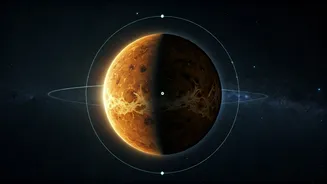
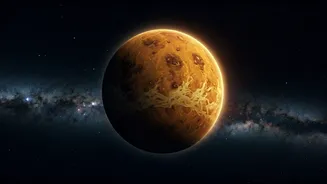
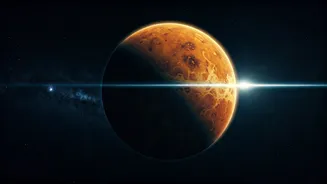
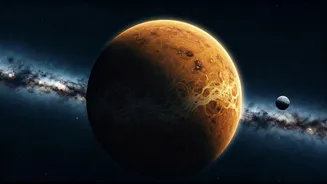
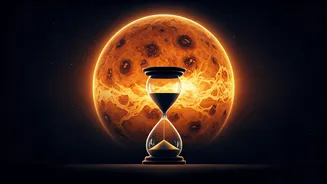
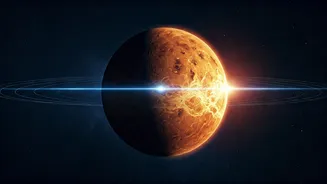
Now, let’s apply these concepts to Venus, where everything gets weird. A year on Venus—the time it takes to orbit the Sun—is about 225 Earth days. This is its 'year.' But a sidereal day on Venus—one full spin on its axis—takes an astonishing 243 Earth days. You read that right. It takes longer for Venus to complete a single rotation than it does for it to complete its entire journey around the Sun. This is the core of the headline's mind-bending claim. A single Venusian sidereal day is about 18 Earth days longer than a full Venusian year. This makes Venus unique in our solar system, a planet where the fundamental rhythms of time are completely alien to our own.
The Slow, Backward Spin
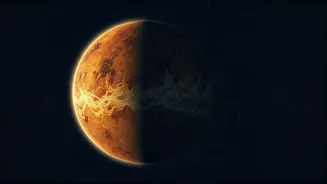
So why is Venusian time so strange? The answer lies in its rotation. Firstly, Venus spins incredibly slowly. While Earth completes a rotation in under 24 hours, Venus takes 243 Earth days to do the same. But it gets even stranger: Venus spins backward. This is known as retrograde rotation. On every other planet in our solar system (except for Uranus, which is tilted on its side), the Sun rises in the east and sets in the west because they spin in the same direction as their orbit. On Venus, the Sun rises in the west and sets in the east. This backward and slow spin creates another bizarre effect on its 'solar day' (from one sunrise to the next). Because the planet is rotating backward as it orbits forward, one sunrise-to-sunrise cycle on Venus takes about 117 Earth days. So, while its rotation period is longer than its year, you'd still experience two sunrises for every trip around the Sun.
Life on a Slow-Cooking Planet
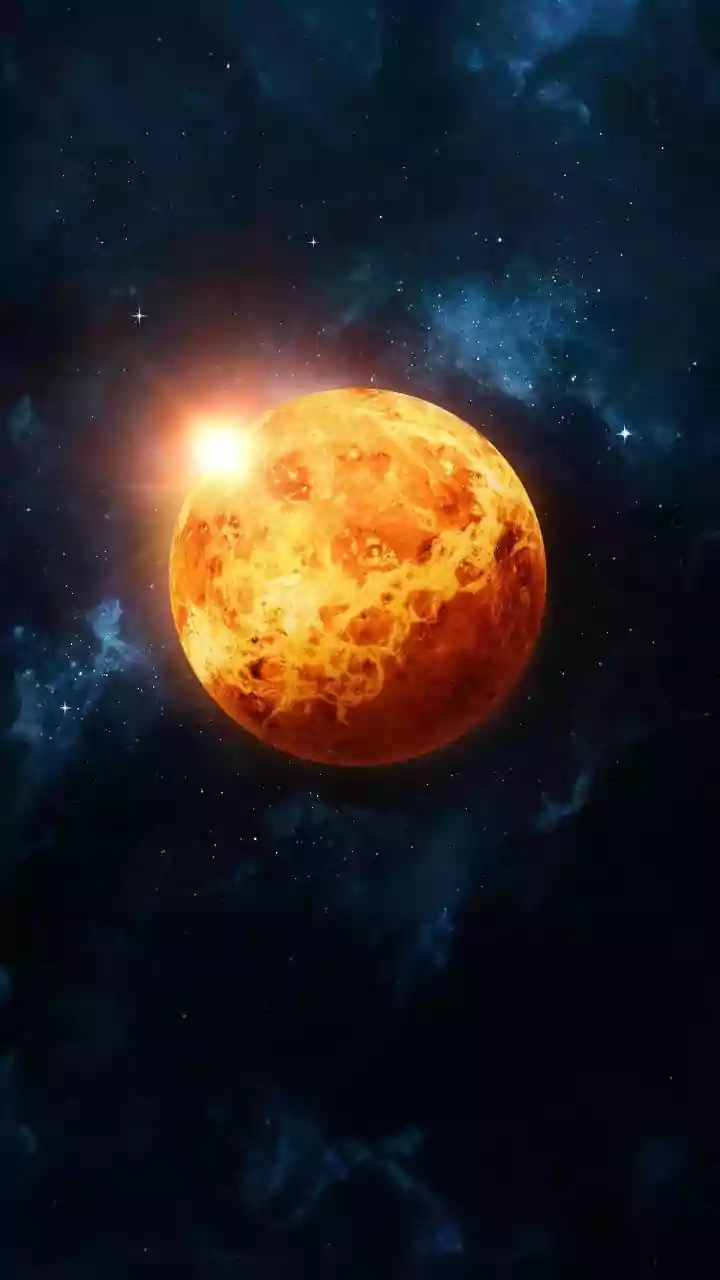
This bizarre timekeeping has profound consequences. With a day-night cycle lasting months, the side of Venus facing the Sun is subjected to an extended, brutal baking period. Temperatures on the surface soar to an average of 465°C, hot enough to melt lead. This extreme heat is trapped by a thick, toxic atmosphere of carbon dioxide and sulphuric acid clouds, creating a runaway greenhouse effect. The night side isn't much of a relief; it remains punishingly hot due to the thick atmospheric blanket circulating the heat. The planet's slow rotation also means it has a very weak magnetic field, leaving it exposed to solar winds that have stripped away any water it may have once had. Life as we know it would be impossible, not just because of the heat and pressure, but because the very concept of a 'day' is a drawn-out, lethargic crawl.
An Unsolved Cosmic Mystery
Scientists are still debating why Venus spins so slowly and in the wrong direction. The leading theories suggest a cataclysmic event in its distant past. Perhaps a massive asteroid or planetary body slammed into Venus, altering its spin. Another theory proposes that the gravitational pull from the Sun on Venus’s incredibly dense atmosphere created an atmospheric tide. Over billions of years, this tidal friction could have acted as a brake, slowing the planet's rotation to a crawl and eventually reversing it. Understanding this mystery is key to understanding how terrestrial planets form and evolve, and why Earth ended up a life-sustaining paradise while its 'twin' became a scorching, inhospitable world.