




A Legacy of Cosmic Discovery
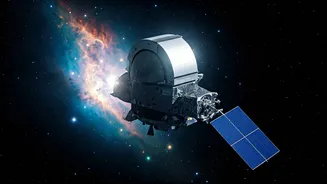
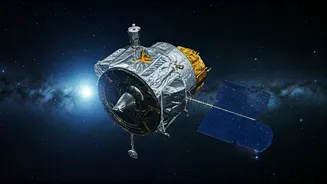
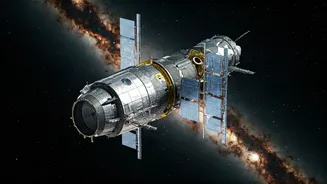
Launched in 2004, the Neil Gehrels Swift Observatory is a space telescope with a very specific and crucial job: detecting gamma-ray bursts (GRBs). These are the most powerful explosions in the universe, marking cataclysmic events like the birth of black
holes or the collision of neutron stars. Swift was designed to be, well, swift. It can autonomously pivot in seconds to catch these fleeting bursts and their afterglows across multiple wavelengths, from X-ray to ultraviolet light, and alert scientists on the ground. Over its 20-year mission, it has observed thousands of GRBs, providing invaluable data that has transformed our understanding of the high-energy universe. It has helped pinpoint some of the most distant objects ever seen and has also become a versatile tool for observing everything from supernovae to comets.
The Slow Descent
Unlike the Hubble Space Telescope, Swift was never designed with a propulsion system to maintain its orbit. For years, it has been slowly losing altitude due to atmospheric drag. This problem has been dramatically accelerated by the recent period of intense solar activity. The active sun has caused Earth’s upper atmosphere to expand, increasing drag on the satellite and pulling it down much faster than predicted. NASA estimates that without intervention, Swift’s orbit will decay to an unrecoverable point by October 2026, after which it would uncontrollably re-enter the atmosphere. To buy a little more time while a rescue could be planned, mission operators powered down Swift's science instruments in early 2026 to minimize its drag profile.
Enter the Robotic Lifesaver
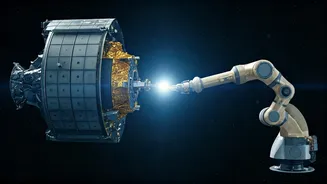
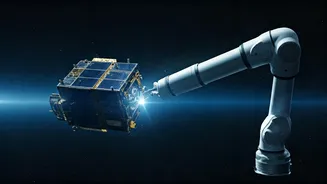
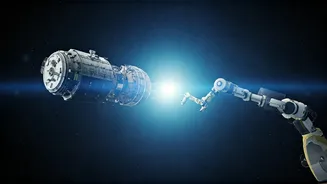
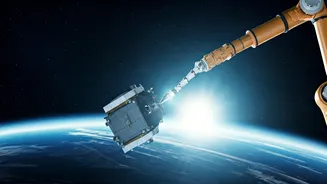
In an unprecedented move, NASA awarded a $30 million contract in September 2025 to a private company, Katalyst Space Technologies, to build a robotic servicing vehicle in less than a year. The result is a spacecraft named LINK, an autonomous tugboat designed to save the ailing observatory. The mission, dubbed Swift Boost, involves launching LINK aboard the final flight of the air-launched Pegasus XL rocket. After reaching orbit, the refrigerator-sized LINK will spend weeks carefully approaching and observing Swift to plan its capture. Since Swift was never designed to be serviced, LINK will use three robotic arms to grapple onto the 1.5-ton satellite at a suitable point.
More Than Just a Repair Job
Once securely attached, LINK will fire its gentle ion thrusters over several months to slowly raise the combined stack back to a stable orbit, aiming for an altitude of about 600 kilometers. This will add years, potentially another decade, to Swift's scientific life. But the mission's importance extends far beyond saving a single telescope. It is a critical test for the future of commercial on-orbit servicing. A successful mission would prove that satellites not designed for docking can be captured and serviced, opening a new paradigm for extending the life of valuable space assets rather than simply replacing them. It's a shift from a disposable to a sustainable model for operating in space, and at a fraction of the cost of launching a replacement observatory.