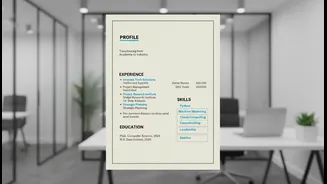









The Core Mindset Shift: From Comprehensive to Concise
An academic CV is a detailed, multi-page record of your entire scholarly life, designed for an audience that values exhaustive detail. In contrast, an industry resume is a one-to-two-page marketing document created for a specific job. Recruiters and hiring
managers often spend only seconds on an initial scan. The primary goal is no longer to list every publication and conference but to quickly demonstrate how your skills solve a company's problems. This means shifting your focus from a comprehensive history of what you’ve studied to a targeted summary of what you can deliver.
Decluttering Your Academic History
The first practical step is to cut information that is irrelevant to a corporate role. Many achievements that are prestigious in academia do not translate directly to industry and can clutter your resume. Sections to drastically shorten or remove entirely include extensive lists of publications, conference presentations, and academic service committees. While a key publication that led to a patent or a major project is worth noting, the full list is unnecessary. Similarly, unless your teaching assistantship involved significant leadership or project management, it can often be condensed or removed. The goal is to make every line on your resume earn its place by being directly relevant to the job you are applying for.
Translating Your Skills, Not Just Listing Them
Academics possess a wealth of valuable skills, but they are often hidden behind academic jargon. The key is to translate these skills into the language of business. For example, managing a research project is project management. Writing a grant proposal demonstrates persuasive communication and financial planning. Your research experience is a testament to your data analysis and problem-solving abilities. Instead of stating you “investigated novel methodologies,” you might say you “developed and implemented new processes that improved efficiency.” Avoid specialized academic slang and use clear, professional language that someone outside your field can easily understand. Frame your experience in terms of skills like leadership, teamwork, communication, and data interpretation.
Focus on Quantifiable Impact
Industry hiring managers want to see results. It's not enough to list your responsibilities; you need to show the impact of your work. Quantify your achievements wherever possible using numbers, percentages, or dollar amounts. Instead of saying you “managed a research budget,” specify that you “managed a ₹50 lakh project budget, delivering the project 10% under budget.” Instead of “taught students,” state that you “mentored and instructed over 200 undergraduate students, resulting in a 15% improvement in final grades.” A popular framework for structuring these points is the STAR method (Situation, Task, Action, Result) or the X-Y-Z formula: Accomplished [X] as measured by [Y] by doing [Z]. This approach provides tangible evidence of your ability to drive results.
Adopting the Industry Standard Format
The structure of an industry resume differs significantly from an academic CV. Typically, a corporate resume begins with a professional summary—a brief 3-5 sentence overview of your key skills and career goals. This replaces the lengthy objective or research interest section. This is followed by a Skills section, then your Experience in reverse-chronological order, and finally Education. In a CV, education is often at the top; in a resume, it's usually at the bottom unless you are a recent graduate. This format is also more friendly to the Applicant Tracking Systems (ATS) that many companies use to screen applications, so be sure to incorporate keywords from the job description.