



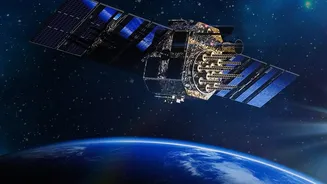


The Sun’s Violent Temper
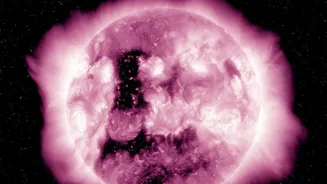
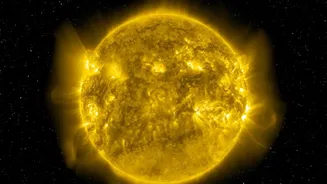
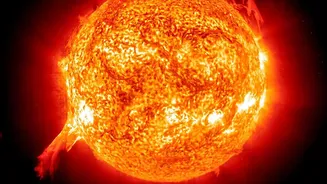
The Sun isn’t just a benign source of light and heat; it has a volatile side. It constantly releases a stream of charged particles known as the solar wind. Sometimes, it unleashes massive, energetic bursts called coronal mass ejections (CMEs). When a CME is aimed
at Earth, it can slam into our planet's magnetic field, triggering a geomagnetic storm. While these storms can create beautiful auroras, they also pose a significant danger to our high-tech infrastructure. A powerful storm could induce strong electrical currents on the ground, potentially overwhelming power grids and causing widespread, long-lasting blackouts. In space, the intense radiation can damage satellite electronics, disrupt communications, and even cause satellites to lose orbit and burn up in the atmosphere.
Introducing DAGGER: A New Cosmic Sentry
To better prepare for these events, an international team of researchers, supported by NASA and other partners, has developed a new tool called DAGGER, which stands for Deep Learning Geomagnetic Perturbation. Unlike previous models that were either slow or limited to specific locations, DAGGER is the first to combine the power of artificial intelligence with real-time data from spacecraft to provide fast, accurate, and global predictions. The lead author of the paper announcing the model, Vishal Upendran of the Inter-University Center for Astronomy and Astrophysics in India, noted that this AI makes it possible to minimize or even prevent devastation to modern society.
How the 30-Minute Warning Works
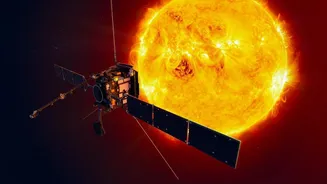
DAGGER’s brilliance lies in its use of deep learning, a type of AI that excels at recognizing patterns in vast amounts of data. Researchers trained the model using information from several heliophysics missions that measure the solar wind, as well as data from ground stations on Earth that observe geomagnetic disturbances. By analyzing the constant stream of solar wind data from satellites, the AI can predict the specific location and intensity of a geomagnetic storm’s impact anywhere on Earth, with 30 minutes of advance warning. While half an hour might not sound like much, it’s a critical window for action. Previous warning systems often provided only a few minutes' notice or less precise forecasts. DAGGER can generate a new prediction in less than a second and updates its forecast every single minute, ensuring operators have the most current information available.
The Real-World Lifeline
That 30-minute lead time is a game-changer for critical industries. Power grid operators could have just enough time to re-route power or take sensitive systems offline to prevent cascading failures. Satellite controllers could orient their spacecraft to better protect delicate electronics or perform manoeuvres to avoid increased atmospheric drag that could alter their orbits. Airlines that use polar routes, where the effects of space weather are strongest, could re-route flights to ensure communication systems remain reliable. With the Sun's activity expected to reach its peak in its 11-year cycle around 2025, the risk of a major storm is increasing, making tools like DAGGER more important than ever.