



The Sun’s Violent Outbursts
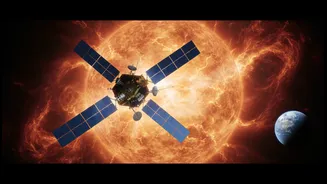
The Sun, our life-giving star, has a tempestuous side. It periodically unleashes solar flares and, more consequentially, Coronal Mass Ejections (CMEs). A CME is a colossal explosion in the Sun's corona that hurls billions of tonnes of magnetised plasma
into space. These clouds of charged particles can travel at speeds ranging from 300 to over 3000 km/s. While Earth's magnetic field, the magnetosphere, deflects most of this solar onslaught, a direct hit from a powerful CME can compress this shield and trigger a geomagnetic storm, wreaking havoc on technology.
Satellites in the Firing Line
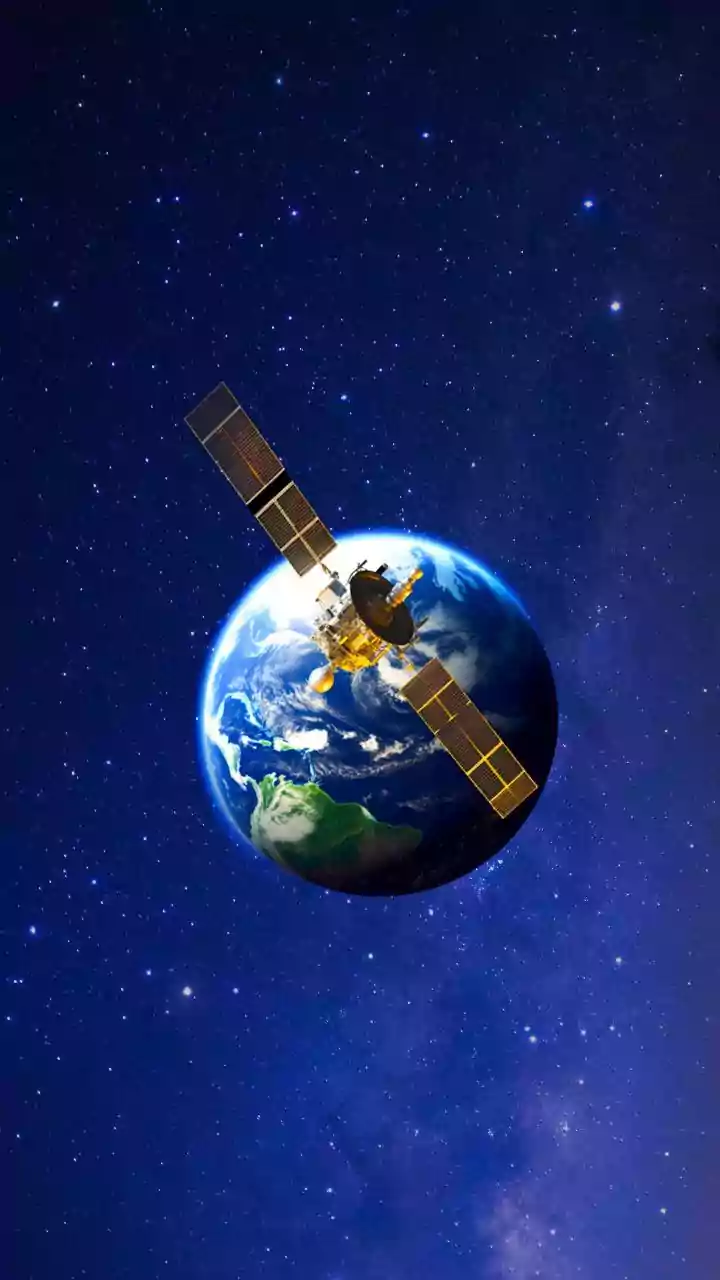
For satellites, especially those in high geosynchronous orbits, a CME is a significant danger. The incoming wave of energetic particles can cause a host of problems. It can lead to 'spacecraft charging,' where a buildup of static electricity results in damaging discharges, essentially short-circuiting sensitive electronics. High-energy particles can cause 'single-event effects,' flipping bits in a computer’s memory and corrupting data or causing malfunctions. Furthermore, a storm can heat and expand Earth’s upper atmosphere, increasing drag on satellites in Low-Earth Orbit (LEO) and shortening their operational lifespan. Given our reliance on satellites for everything from GPS and communication to banking and weather forecasting, protecting them is a matter of national and economic security.
An Early Warning System in Space
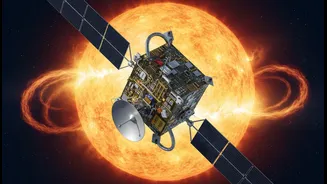
This is where real-time space data becomes crucial. To get a warning, we need 'eyes' on the Sun. This role is filled by dedicated solar observatories strategically placed in space. A key location is Lagrange Point 1 (L1), a point of gravitational stability about 1.5 million kilometres between the Earth and the Sun. From here, spacecraft get an uninterrupted view of solar activity. Missions like NASA's Deep Space Climate Observatory (DSCOVR) and India’s first solar observatory, Aditya-L1, are stationed at L1. They act as celestial buoys, monitoring the solar wind—the constant stream of particles from the Sun—and detecting the blast wave from a CME up to 60 minutes before it reaches Earth.
From Data to Defensive Action
When a mission like DSCOVR or Aditya-L1 detects a CME heading our way, it transmits data on its speed, density, and magnetic field orientation back to Earth. This information is fed into space weather prediction models managed by agencies like NOAA's Space Weather Prediction Center (SWPC) in the U.S. and is crucial for India's own developing prediction program. Researchers and forecasters analyse this data to determine the arrival time and potential severity of the geomagnetic storm. This advanced warning is the critical window that allows satellite operators to act.
The Art of 'Shielding' a Satellite
The term 'shielding' in this context rarely means raising a physical barrier. While satellites do have some built-in radiation hardening, the primary defense is operational. With a forecast in hand, operators can take protective measures. The most common action is to place the satellite into a 'safe mode'. This involves shutting down non-essential systems, securing sensitive instruments, and orienting the spacecraft to present the most protected profile to the incoming particle storm. By temporarily powering down delicate electronics, operators can prevent them from being fried by particle-induced electrical surges. For aircraft, which also rely on satellite communication and navigation, these forecasts allow for rerouting flights away from polar regions where radiation effects are strongest.