








What Are Content Credentials?
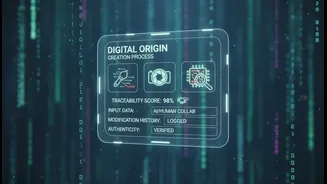
Think of Content Credentials as a digital 'nutrition label' for media. It's a securely attached piece of information that tells the story of a digital file, like a photo, video, or audio clip. This technology, built on an open standard called C2PA (Coalition
for Content Provenance and Authenticity), is backed by a consortium of major tech and media companies including Adobe, Microsoft, Google, and the BBC. When a creator or a tool saves a file with these credentials, it embeds a tamper-evident record of its origin and history. This information is cryptographically signed, meaning if someone tries to alter the history, the digital 'seal' is broken, and the tampering becomes visible.
How They Create Transparency
The primary function of Content Credentials is to provide a clear, traceable history—its provenance. This includes details like who created the content (if they choose to share it), what tool was used, and, crucially in the modern era, whether generative AI was involved in its creation or editing. For example, a credential can show that an image was captured on a specific camera model, edited in Adobe Photoshop to adjust contrast, and then published by a news organisation. This detailed log is attached to the file itself and can be viewed by anyone using a verification tool, often by clicking a small 'CR' icon. This transparency allows viewers to see the steps a piece of content has taken, from capture to publication, providing an unprecedented level of insight into its production.
The Gap Between Transparency and Truth
Herein lies the critical distinction highlighted by the headline: transparency is not the same as truth. A Content Credential can tell you that an image was generated by AI, but it can't tell you why. Was it created for a satirical post, a piece of digital art, or a malicious misinformation campaign? The credential doesn't know. Similarly, a credential can verify that a photograph was taken by a real camera at a specific time and place. However, it cannot tell you if the scene was staged, if the framing is deliberately misleading, or if the accompanying caption is false. The C2PA standard certifies the history of a file, not the truthfulness of the reality it claims to represent. The technology provides the facts of creation, but the burden of judging the content's meaning and intent still falls squarely on the viewer.
A Tool, Not a Silver Bullet
Content Credentials face significant practical limitations. One of the most glaring is what's known as the 'screenshot loophole' or 'analog hole'; if you take a screenshot of an AI-generated image, the new file has no history and thus no credential. Furthermore, many social media and messaging platforms have historically stripped metadata from uploaded files to save space, which would erase any attached credentials, though this is slowly changing. There's also the 'missing label' dilemma: as users get accustomed to seeing credentials, they may automatically distrust the billions of legitimate photos and historical images that were created without them. These issues underscore that credentials are a powerful tool for adding context, but they are not a foolproof system for eliminating fake content.
Relevance in the Indian Context
For India, a nation grappling with the rapid spread of misinformation across platforms like WhatsApp, the potential of such a technology is immense. The Indian government has already signalled a strong interest in regulating AI-generated content, pushing for clear labelling. While full adoption is still nascent, some Indian organisations have joined the Content Authenticity Initiative. However, the real challenge lies in bridging the gap between technological standards and public awareness. For Content Credentials to be effective, there needs to be widespread implementation by tech platforms and, more importantly, a significant increase in digital literacy among the public to understand what these new 'nutrition labels' are actually telling them.