





A New Shape in the Clouds
Scientists using NASA's Hubble Space Telescope have confirmed the existence of a massive, 10-sided atmospheric wave, or decagon, encircling Saturn's south pole. This is the first time such a large, regular geometric pattern has been observed in the planet's
southern hemisphere. The discovery came as a surprise, especially since NASA's Cassini spacecraft, which orbited Saturn from 2004 to 2017, saw no hint of such a long-lived structure. The feature appears to be a recent development. Faint traces were found in Hubble images from 2023, with the pattern becoming much more distinct in observations made in 2024 and 2025. This recent emergence was made possible to observe thanks to Saturn's slow, 29.5-year orbit, which has gradually tilted its south pole back into Earth's view after years of being hidden.
Beyond the Famous Hexagon
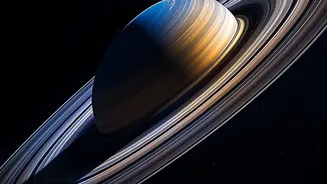
This new decagon invites immediate comparison to Saturn's famous northern hexagon, a six-sided jet stream that has been stable for over 40 years since its discovery by the Voyager probes. The hexagon, which is wide enough to engulf two Earths, has long been considered a unique feature in the solar system. The discovery of a southern polygon suggests that such geometric storms might be a more fundamental characteristic of Saturn's atmosphere than previously believed. However, the two shapes are not perfect mirror images. The new decagon is located at a different latitude than its northern counterpart and appears less stable, as it has only recently formed. While the hexagon is largely stationary, the decagon is observed to drift eastward at a relatively slow pace. These differences provide scientists with a valuable opportunity to study what makes these strange weather patterns tick.
The Power of a Jet Stream
The leading explanation for these giant polygons lies in the planet's powerful jet streams. The 10-sided pattern appears to be a massive, meandering wave riding on one of Saturn's eastward jets. In essence, scientists believe that a steep difference in wind speeds within the atmosphere can create turbulence that organises itself into a stable polygonal shape. Laboratory experiments on Earth, using rotating tanks of liquid, have successfully recreated these phenomena, producing shapes with three to eight sides depending on the fluid properties and rotation speeds. These experiments show that vortices form along the boundary between fast- and slow-moving fluids and space themselves out, creating the geometric effect. The fact that this decagonal wave appears to extend deep into multiple layers of Saturn's atmosphere suggests it is a significant, vertically-structured phenomenon, not just a superficial cloud pattern.
Unlocking Planetary Weather
The discovery of the decagon is more than just a curiosity; it's a crucial clue for understanding the meteorology of gas giants. It shows that the conditions in Saturn's atmosphere can support the formation of these giant polygonal waves in both hemispheres. Researchers, led by Agustín Sánchez-Lavega of the University of the Basque Country, are now trying to understand why the decagon has ten sides and why it formed so recently. One theory suggests a link to a large, high-pressure vortex—an anticyclone—spotted near the decagon, which could be forcing the jet stream into its 10-sided shape. Observing how the new pattern evolves as Saturn's southern hemisphere moves into its summer season could reveal much more about its formation and stability. Ultimately, comparing the new decagon with the long-standing hexagon will help refine the complex models that describe how weather and atmospheric dynamics work on planets so different from our own.