





What is an Opposition?
In simple terms, an opposition is a perfect cosmic alignment. It happens when Earth passes directly between the Sun and an outer planet, like Saturn. Imagine the Sun, Earth, and Saturn forming a straight line in space, with our planet in the middle. This
alignment places Saturn on the opposite side of our sky from the Sun. As the Sun sets in the west, Saturn rises in the east, remaining visible throughout the night before setting in the west around sunrise. This event also marks the planet's closest approach to Earth for the year, making it appear bigger and brighter than at any other time. Saturn reaches opposition about every 378 days, so we get this opportunity roughly once a year.
A Special View in 2026
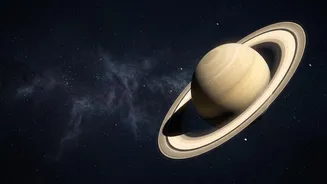
This year's opposition on October 4 is particularly special for stargazers. In 2025, Saturn's rings were tilted edge-on to us, making them seem to disappear entirely. Now, in October 2026, the rings are once again visible, tilted at about 7 degrees towards us, offering a clear and beautiful sight through a telescope. Furthermore, around the time of opposition, the rings can appear unusually bright due to a phenomenon called the Seeliger effect, or opposition surge. This happens because the sunlight illuminating the icy particles in the rings comes from directly behind us, hiding the tiny shadows the particles usually cast on each other. This effect, most noticeable for a few days around October 4, makes the rings flare with extra brightness.
How to See Saturn from India
You don't need to be an expert astronomer to enjoy this celestial show. Saturn is one of the brightest objects in the night sky right now, shining with a steady, yellowish light. For observers in India, Saturn rises in the eastern sky at around 6:11 pm on October 4 and will be visible all night long, reaching its highest point in the sky just after midnight. The planet sets at approximately 6:23 am the next morning. To spot it, just look east after sunset for a bright, star-like point that doesn't twinkle. While the planet itself is visible to the naked eye, its famous rings are not. Even so, you don't have to miss out on the best part. The good news is that you don't need to wait for the exact date of opposition; Saturn will remain a brilliant target for several weeks.
Using Binoculars and Telescopes
To get a true sense of Saturn's majesty, you'll want some optical aid. Even a basic pair of high-powered binoculars might reveal that the planet is not perfectly round, but slightly elongated. However, to clearly see the rings as separate from the planet, a telescope is necessary. A small telescope with a magnification of 25x to 50x is enough to reveal the iconic rings, a sight that has captivated skywatchers for centuries. If you have access to a larger instrument, you might even be able to spot the Cassini Division—a dark gap between the main rings—or Saturn's largest moon, Titan, which appears as a small star-like point nearby. For the best view, wait until the planet is high above the horizon, away from the turbulent air near the ground. If you don't own a telescope, check with local astronomy clubs or planetariums, which often host public viewing events for occasions like this.