





A New Shape in the Clouds
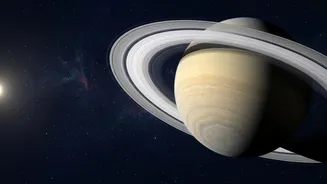
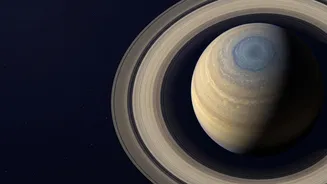
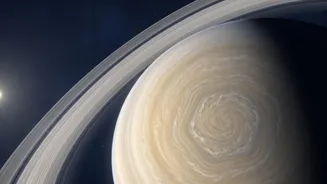
Astronomers have discovered a colossal ten-sided atmospheric pattern, or decagon, encircling Saturn’s south pole. This massive structure was identified using recent images from the Hubble Space Telescope. Spanning roughly 167,000 kilometers across, the feature
is a vast wave embedded within one of the planet's powerful jet streams. The discovery was led by a team of planetary scientists who published their findings in the journal Science Advances, confirming a new type of geometric marvel in our solar system. Interestingly, the first hints of this strange pattern were noticed by amateur astronomers in 2024, whose ground-based observations helped guide the professional follow-up.
A Counterpart to the Famous Hexagon
For decades, the only known planetary polygon was Saturn’s famous hexagon, a six-sided jet stream at its north pole first spotted by the Voyager spacecraft in the 1980s. That storm has remained remarkably stable for over 40 years. Scientists had long searched for a similar structure in the southern hemisphere, but none was ever detected, not even by the Cassini spacecraft, which orbited Saturn from 2004 to 2017. The planet's axial tilt kept the south pole largely hidden from Earth’s view from around 2012 until 2023. When Hubble was able to get a clear look again, the decagon was there, suggesting it is a relatively new phenomenon that formed only in the last few years.
The Science of Celestial Geometry
The discovery has sent scientists scrambling to understand its origins. The leading theory for both the hexagon and the new decagon is that they are manifestations of meandering waves within fast-moving jet streams. Just as a river's flow can be shaped by its banks, the winds in Saturn’s atmosphere can be contorted by other atmospheric pressures into stable, geometric patterns. Computer simulations have shown this is possible, though no model has yet perfectly recreated a ten-sided structure. One hypothesis is that a nearby high-pressure vortex, a kind of smaller, anticyclonic storm, may be influencing the jet stream and forcing it into a decagonal shape. Unlike its stable northern cousin, the southern decagon appears to be evolving, giving scientists a rare chance to watch a planetary-scale weather pattern take shape in real time.
More Than Just a Cloud Pattern
This ten-sided wonder is not just a pretty pattern on the surface. By observing it through different light filters, which probe different depths in the atmosphere, scientists have determined that the decagon is a deep, vertically stacked structure. This means the wave extends thousands of kilometers down through multiple cloud layers, indicating it is a fundamental feature of Saturn’s atmospheric dynamics, not just a superficial phenomenon. The key question puzzling researchers is why now? Amy Simon, a scientist at NASA's Goddard Space Flight Center, noted that the recent formation is the most intriguing part of the discovery, raising fundamental questions about the triggers for such massive atmospheric events.