



A New Window on Cosmic Nurseries
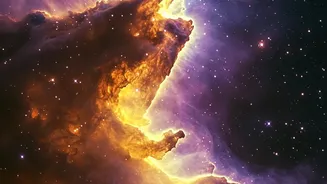
Stars are born inside vast, cold clouds of gas and dust known as stellar nurseries. As gravity pulls this material together, dense pockets collapse and heat up, forming a protostar—the hot, dense core of a future star. This entire process, however, is obscured
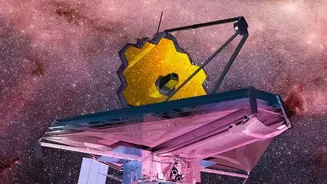
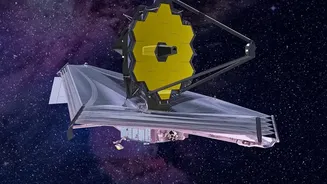
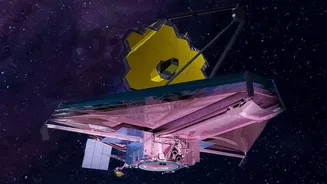
by the very dust that fuels it, making it invisible to telescopes that see in visible light, like Hubble. The James Webb Space Telescope (JWST) is a game-changer because it is designed to see the universe in infrared light. These longer wavelengths can penetrate the thick veils of dust, allowing astronomers to finally witness the chaotic and beautiful first moments of a star's life. What was once an opaque wall of darkness is now a detailed landscape of creation.
The Fiery Hourglass of Creation
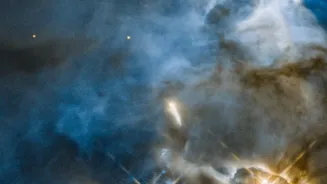
One of the most breathtaking images from Webb shows a protostar called L1527, located about 460 light-years away. The image reveals a spectacular, fiery hourglass shape glowing in vibrant shades of orange and blue. This is not the star itself, but a cavity in the surrounding gas and dust illuminated by the star's light. The protostar, a mere 100,000 years old, is hidden from direct view inside the narrow “neck” of the hourglass. Clearly visible as a dark line across this neck is a protoplanetary disk—a spinning belt of dense gas and dust the size of our own solar system. This disk is not just obscuring the star; it is actively feeding it material, helping it grow. In time, the leftover material in this very disk will clump together to form planets, moons, and asteroids.
Supersonic Jets from a Baby Sun
Webb’s observations have also provided unprecedented detail on another key part of the birth process: powerful jets of gas. Images of Herbig-Haro 211 (HH 211), an infantile star about 1,000 light-years away, show a pair of symmetric jets shooting out from its poles at supersonic speeds. These jets are formed when some of the material spiraling toward the protostar gets caught in magnetic fields and ejected at high velocity. As this material slams into the surrounding interstellar gas, it creates brilliant shockwaves that cause the molecules to glow, outlining the outflows in stunning detail. These jets are not just a byproduct; they play a crucial role in regulating the star's growth by carrying away excess angular momentum, which would otherwise cause the rapidly spinning protostar to fly apart.
Putting the Pieces Together
By combining observations of objects like L1527 and HH 211, a clearer picture of the stellar birth process is emerging. It begins with the gravitational collapse of a dust cloud, forming a hot protostar at its center. This protostar is fed by a rotating accretion disk, which will later form planets. As the star gathers mass, it launches powerful jets that clear out the surrounding area, effectively stopping other stars from forming nearby and allowing the dominant star to hog the raw material for itself. What Webb is showing us is that star birth is not a gentle, quiet event. It is a dynamic and violent process of accretion and ejection, a cosmic tug-of-war that shapes not only the star itself but the entire future planetary system that will one day orbit it. Webb has even detected what might be an unresolved binary star at the heart of HH 211, suggesting its jets are powered by two stars dancing together.