

The Universe’s Oldest Story
To understand the universe's infancy, scientists are hunting for its most abundant element: hydrogen. In the dark era before the first stars ignited, the cosmos was filled with vast clouds of neutral hydrogen. These atoms naturally emit a faint radio
signal with a specific wavelength of 21 centimetres. This signal acts like a cosmic fingerprint, carrying information from an epoch we can't see with conventional telescopes. As the universe has expanded over billions of years, these primordial radio waves have been stretched to much longer wavelengths. By detecting these stretched, or 'redshifted', signals today, astronomers can effectively look back in time and map the structure of the universe as it was more than 10 billion years ago. This technique, called hydrogen intensity mapping, is a revolutionary way to survey the cosmos without needing to see individual stars or galaxies.
A Telescope Unlike Any Other
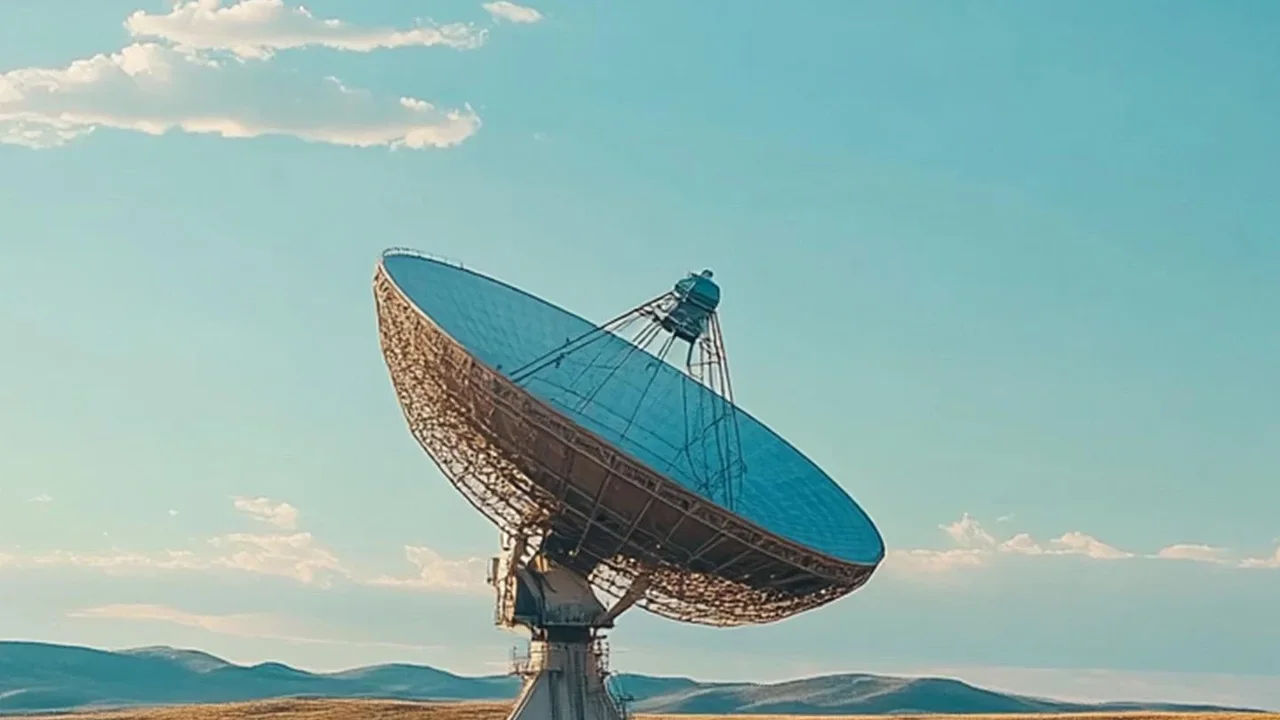
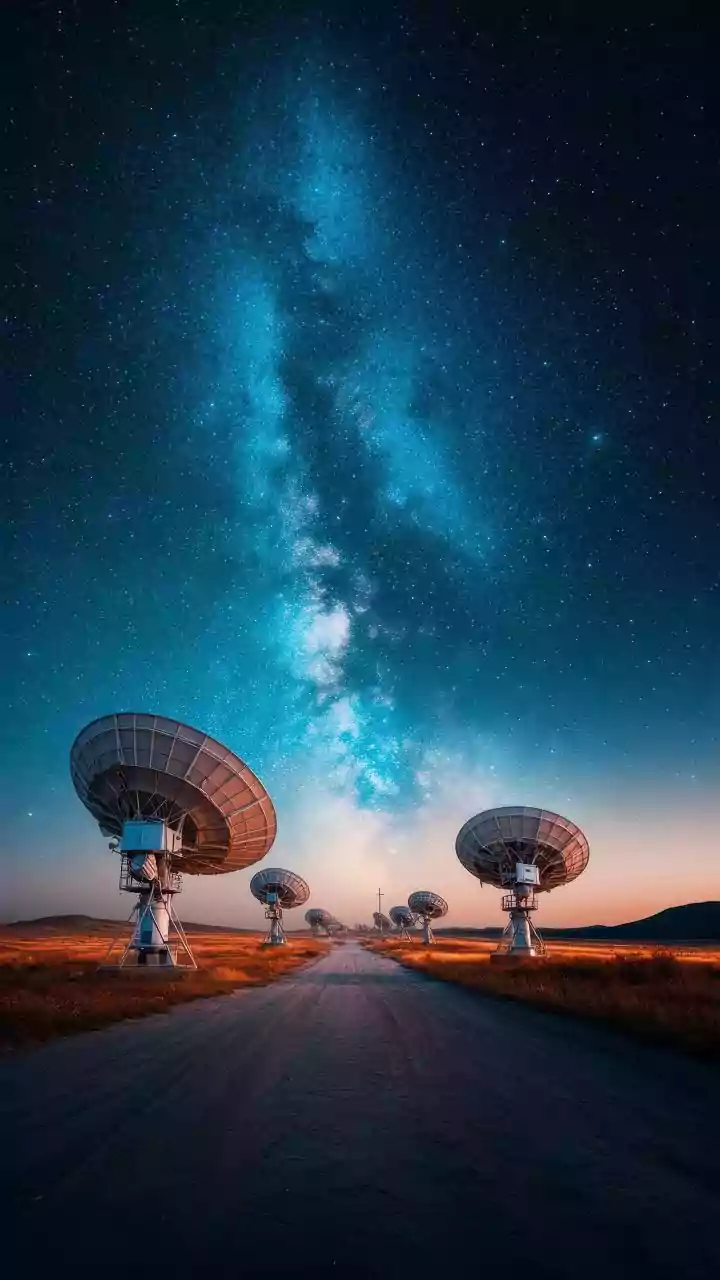
The tool at the heart of this quest is the Canadian Hydrogen Intensity Mapping Experiment, or CHIME. Located in British Columbia, Canada, CHIME doesn't look like a typical satellite dish. It consists of four massive, stationary half-pipe-shaped cylinders, each 100 metres long. With no moving parts, it uses the Earth's rotation to scan a huge portion of the northern sky every single day. This design makes it exceptionally good at creating vast, three-dimensional maps of the sky over time. While CHIME has gained fame for detecting hundreds of mysterious Fast Radio Bursts (FRBs), its primary mission is cosmological. It was specifically built to capture the faint, redshifted 21cm signals from ancient hydrogen, using a powerful supercomputer to process the immense amount of data it collects.
Peering into the Cosmic Dawn
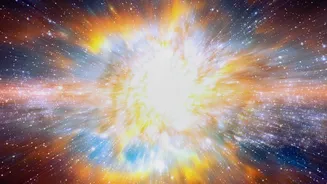
CHIME is trying to illuminate a mysterious period known as the 'Epoch of Reionization'. After the Big Bang, the universe cooled and went dark for a few hundred million years, a period fittingly called the Cosmic Dark Ages. Then, the very first stars and galaxies began to form. Their intense ultraviolet radiation started to heat and ionise the surrounding clouds of neutral hydrogen, like billions of little lamps turning on and clearing away a cosmic fog. This transformed the universe from a neutral, opaque state to the ionised, transparent one we see today. The 21cm hydrogen signal is a direct probe of this crucial transition. By mapping how the hydrogen was distributed just before and during this era, astronomers can create a 'movie' of how the first large-scale structures in the universe took shape.
Solving the Mystery of Dark Energy
One of the biggest goals for CHIME is to tackle the puzzle of dark energy, the enigmatic force that is causing the expansion of the universe to accelerate. To do this, astronomers are looking for the imprint of something called Baryon Acoustic Oscillations (BAO). These were sound waves that rippled through the hot, dense early universe, leaving behind a characteristic pattern in the distribution of matter. This pattern, which acts like a giant, cosmic ruler, expanded along with the universe. By measuring the size of this 'ruler' at different points in cosmic history using the 21cm hydrogen map, scientists can precisely track the expansion history of the universe. This data is most crucial for the period when dark energy began to dominate, giving scientists the clues needed to understand its properties.
The Challenge of a Whisper in a Storm
This research is incredibly challenging because the ancient hydrogen signal is astonishingly faint. It is buried under a sea of radio noise from our own Milky Way galaxy and other celestial objects that is up to a million times louder. Isolating this cosmological whisper from a hurricane of foreground noise is one of the greatest technical hurdles in modern astronomy. Recent breakthroughs by the CHIME collaboration, with key contributions from Indian institutions like the Raman Research Institute, have shown for the first time that a single ground-based telescope can successfully detect this signal without relying on other surveys. This milestone proves the hydrogen intensity mapping technique is viable, paving the way for future discoveries with CHIME and next-generation telescopes.