




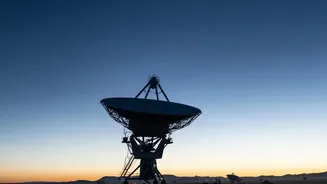


The World's Largest Telescope
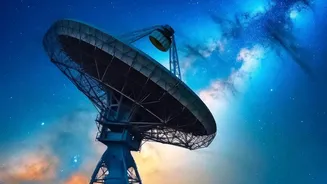
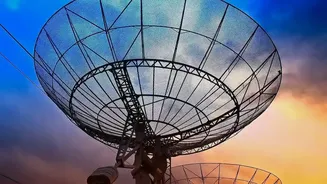
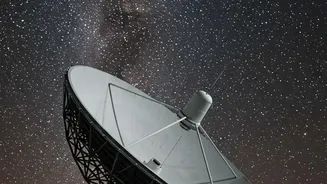
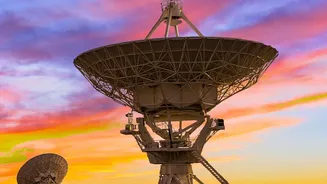
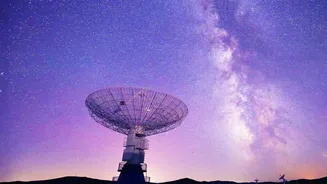
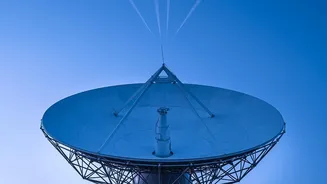
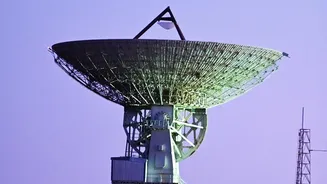
Don't picture a single, colossal dish. Instead, imagine a continent-spanning network of antennas all working as one giant, ultra-sensitive ear. The Square Kilometre Array isn't one telescope, but two. SKA-Low, in Western Australia, will eventually consist
of over 131,000 tree-like antennas, stretching across 65 kilometres of remote landscape. Its counterpart, SKA-Mid in South Africa, will feature nearly 200 traditional dish antennas. Construction officially began in late 2022, and today marks a crucial step forward as components of this vast network begin to be integrated and tested, starting their long-awaited scan of the heavens. When fully operational around 2028, it will be 50 times more sensitive than any previous radio instrument, capable of mapping the sky at speeds beyond our current capabilities.
Listening to the Universe's Whispers
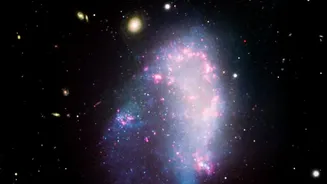
So, what exactly is the SKA listening for? The 'faint cosmic radio signals' in the headline are the echoes of the universe's infancy. One of its primary missions is to probe the 'Cosmic Dawn' and the subsequent Epoch of Reionization—the period just a few hundred million years after the Big Bang when the very first stars and galaxies ignited. These first celestial bodies emitted radiation that transformed the dark, neutral hydrogen filling the universe, and the SKA is designed to detect the faint signature of this pivotal moment. By capturing these ancient radio waves, scientists hope to create a 3D map of the early universe, essentially watching the first large-scale structures form in real time and answering fundamental questions about how the cosmos evolved from a uniform soup of gas into the complex web of galaxies we see today.
What Cosmic Mysteries Could We Uncover?
The SKA's scientific goals are as vast as its physical scale. Beyond peering back to the universe's birth, it will tackle some of the biggest puzzles in modern physics. Astronomers will use the telescope to test Albert Einstein's theories of gravity with extreme precision by timing the signals from pulsars—rapidly spinning neutron stars that act as incredibly accurate cosmic clocks. The telescope will map the cosmic magnetic fields that play a crucial but poorly understood role in galaxy formation. It will survey billions of galaxies to shed light on the mysterious forces of dark energy and dark matter. And yes, its unprecedented sensitivity means it will also conduct the most comprehensive search yet for signs of extraterrestrial intelligence (SETI), listening for potential technosignatures from distant star systems.
A Global Effort with Indian Expertise
The SKA is a massive global collaboration, and India is a key player. As a full member of the SKA Organisation, India has committed ₹1,250 crore to the project. This isn't just a financial contribution; Indian scientific expertise is at the heart of the telescope's brain. The National Centre for Radio Astrophysics (NCRA) in Pune has led the international consortium responsible for designing the Telescope Manager—the complex software system that will act as the SKA's 'central nervous system', controlling and monitoring all telescope operations. Indian scientists and engineers are also making significant contributions to the data processing hardware and software, leveraging the experience gained from operating the acclaimed Giant Metrewave Radio Telescope (GMRT) near Pune, itself an important pathfinder for the SKA.
The Road Ahead and the Data Deluge
While today marks a significant milestone, the completion of the SKA is a phased process set to continue until the end of the decade. Different sections of the array will be brought online incrementally, with early science observations beginning well before the entire project is finished. One of the biggest challenges ahead is not just building the telescope, but managing the data it will produce. The SKA will generate more data in a single day than the entire internet currently creates. Processing, storing, and distributing this information to scientists around the world will require a global network of supercomputing facilities, a challenge that represents a new frontier in big data science.