




Mark Your Calendar: October's Meteor Showers
October is a prime month for shooting stars, hosting two notable meteor showers. First are the Draconids, peaking on the evening of October 8-9. This is an ideal shower for beginners because it's best viewed right after nightfall, meaning no late nights
are required. With the New Moon on October 10, the sky will be perfectly dark, creating excellent viewing conditions for this typically modest shower. Later in the month, the Orionids, born from the debris of Halley's Comet, will grace the sky. This shower peaks in the pre-dawn hours of October 21-22. You can expect to see around 15 to 25 fast, bright meteors per hour in a dark sky. While a bright moon will be present for part of the night, it sets around 3 a.m., leaving a window of dark sky until dawn for optimal viewing.
A Parade of Planets
October 2026 offers a fantastic planetary lineup. The star of the show is Saturn, which reaches opposition on October 4. This means it will be at its closest and brightest for the year, rising around sunset and remaining visible all night long. While you need a telescope to see its famous rings, its bright, steady, yellowish light is easily visible to the naked eye. Jupiter, another brilliant beacon, will be visible in the early morning sky, rising after midnight. Reddish Mars also joins the pre-dawn display, growing brighter throughout the month. On the morning of October 5, you can spot the crescent Moon positioned near Mars. Though more challenging to spot, Venus and Mercury may be seen very low on the western horizon just after sunset early in the month.
Escape the City Glow
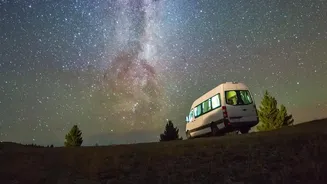
The single most important factor for good stargazing is a dark sky. City lights create 'light pollution,' a glow that washes out all but the brightest celestial objects. For the best experience, plan a trip away from urban centres. Even driving an hour away from city limits can make a dramatic difference. National parks, rural areas, and hill stations are excellent choices. Locations in India famous for their dark skies include Ladakh, Spiti Valley, parts of the Rann of Kutch, and Coorg. However, you don't need to travel far; a local park or a remote beach can also serve as a great viewing spot. The key is to find a location with a wide, unobstructed view of the horizon, away from direct sources of light.
The Right Tools (and None are a Telescope)
While this guide is about avoiding a telescope, a few simple tools can enhance your experience. A pair of standard binoculars can be a game-changer, revealing details on the Moon's surface and bringing fainter star clusters into view. Next, your smartphone can become your personal planetarium. Apps like Stellarium, SkyView Lite, and Star Walk 2 use your phone's location to show you a real-time map of the sky. Just point your phone up, and the app will identify stars, constellations, and planets. Finally, to preserve your night vision, use a red-light torch instead of a bright white one. It takes about 20-30 minutes for your eyes to fully adapt to the dark, and a single glance at a bright phone screen or flashlight can reset that process.
How to Actually Watch the Sky
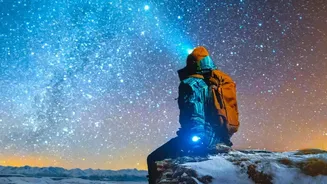
Stargazing is an art of patience. Once you've found your dark spot, get comfortable. A reclining chair or a blanket on the ground will save you from neck strain. Dress in warm layers, as even pleasant evenings can get chilly when you're sitting still for long periods. When you start, just look up and let your eyes adjust for at least 20 minutes. Avoid looking at your phone. For meteor showers, you don't need to look at a specific point; the meteors can appear anywhere in the sky. Just lie back and take in as wide a view as possible. For spotting faint objects, try a technique called 'averted vision'—instead of staring directly at your target, look slightly to the side. This uses the more light-sensitive parts of your eye, making faint objects appear more clearly.