



2001: A Space Odyssey (1968)
No list of cinematic space epics is complete without Stanley Kubrick’s masterpiece. Decades before the advent of modern CGI, Kubrick and his team pioneered visual effects that remain breathtaking today. The film’s genius is its commitment to realism,
using meticulously crafted models, massive rotating sets to simulate gravity, and innovative photographic techniques like front projection and slit-scan photography for the iconic 'Star Gate' sequence. It’s a slow, deliberate, and meditative journey that uses its visuals—from the graceful dance of spacecraft to Johann Strauss's 'The Blue Danube' to the final, psychedelic trip beyond the infinite—to evoke a sense of awe and existential wonder. The film won an Oscar for its visual effects and established a benchmark for what science fiction could achieve on screen.
Interstellar (2014)
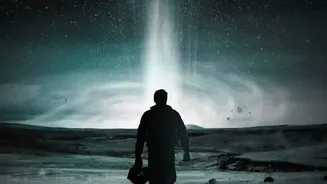
Christopher Nolan’s ambitious epic is as much a scientific document as it is a blockbuster film. To create the movie's stunning celestial phenomena, the visual effects team collaborated with theoretical physicist Kip Thorne to ensure scientific accuracy. They developed new software to render the black hole, Gargantua, resulting in a depiction so groundbreaking that it led to the publication of scientific papers. The visual of the accretion disk, a glowing halo of matter spinning around the black hole, is a mesmerising and scientifically informed piece of imagery. Beyond the black hole, the film dazzles with its depiction of a traversable wormhole, towering 4,000-foot waves on a distant planet, and the tangible feel of its spacecraft interiors, blending practical sets with seamless digital effects.
Gravity (2013)
More of a survival thriller set in orbit than a traditional exploration film, 'Gravity' is arguably one of the most immersive cinematic experiences ever created. Director Alfonso Cuarón and cinematographer Emmanuel Lubezki place the audience directly in the helmet of Dr. Ryan Stone (Sandra Bullock). The film is famous for its long, seamless takes, including a remarkable 12-minute opening sequence that establishes the beauty and peril of space. To achieve the look of zero gravity and the unfiltered light of space, the team invented a 'Light Box'—a cube lined with millions of LED lights—to perfectly simulate the lighting on the actors. The result is a visceral, heart-pounding experience that brilliantly conveys the terrifying emptiness and disorienting reality of being adrift in the void.
Dune (2021 & 2024)
Denis Villeneuve’s adaptation of Frank Herbert's novel is a masterclass in world-building and scale. The visual language of 'Dune' is defined by its colossal architecture and tangible realism. Production designer Patrice Vermette drew inspiration from Brutalist architecture, Mayan temples, and WWII bunkers to create a universe that feels ancient and futuristic at the same time. Rather than relying on green screens, the production built enormous, practical sets, which allowed cinematographer Greig Fraser to light scenes with a naturalism that makes the desert planet of Arrakis feel like a real, sun-scorched place. The sheer size of everything, from the ornithopters to the sandworms, is designed to make the human characters seem small, emphasizing the overwhelming and hostile beauty of this alien world.
Blade Runner 2049 (2017)
While it leans more towards dystopian future than pure space exploration, Denis Villeneuve and cinematographer Roger Deakins created a visual masterpiece that is undeniably immersive. The film expands on the original's noir aesthetic, creating unforgettable cityscapes of a smog-choked, neon-lit Los Angeles and a dust-covered, radioactive Las Vegas. Deakins, who won an Academy Award for his work, uses light, shadow, and heavy atmospherics like fog and mist to craft painterly compositions in every frame. The use of a deliberate, striking color palette—from the sickly yellow of the Vegas ruins to the ethereal pinks and purples of holographic advertisements—is not just for show; it enhances the story's themes of artificiality, memory, and what it means to be human.