





As November nights turn crisp and clear, the cosmos puts on a spectacular show. Even from the bright heart of an Indian city, some of the sky's most famous star patterns are waiting to be found. Here’s your guide to finding two of them.
November: A Gateway to Winter Stars
Winter is widely
considered the best season for stargazing in India. The air is often less hazy, the nights are longer, and some of the brightest constellations take centre stage. November marks the grand entrance of this celestial parade. By mid-to-late November, you no longer have to stay up past midnight to greet the season's main attraction: Orion, the Hunter, which starts rising in the east in the late evening. It's the perfect time for beginners, as the skies are filled with bright, easily recognisable markers that can guide you across the cosmos without any special equipment.
How to Find Orion, The Great Hunter
Orion is arguably the easiest constellation to identify, making it the perfect starting point. Don't look for a complex drawing; instead, search for its most famous feature: Orion's Belt. This is a short, straight line of three medium-bright stars (named Alnitak, Alnilam, and Mintaka). From anywhere in India, look towards the eastern sky from around 10 PM onwards in mid-November. You will spot these three stars rising together. Once you've found the belt, the rest of the hunter's body is easy to trace. Look for two bright stars on either side of the belt. The reddish star is Betelgeuse, which marks Orion's shoulder, while the brilliant blue-white star is Rigel, marking his foot. Below the belt, you might even spot a faint, fuzzy patch of light if you're in a less polluted area. This is the magnificent Orion Nebula, a stellar nursery where new stars are being born, visible even from cities with a small telescope or binoculars.
Using Orion to Spot Taurus, The Bull
Once you've mastered finding Orion, you can use it as a signpost to locate its celestial neighbour, Taurus. Follow the line of Orion's Belt upwards and to the right. This imaginary line will point you directly to a bright, orange-red star named Aldebaran. This star represents the fiery eye of the bull. Aldebaran is the 14th brightest star in the night sky and is part of a V-shaped cluster of stars called the Hyades, which forms the bull's face. If you continue tracing that same line from Orion's belt past Aldebaran, you'll run into a tiny, shimmering cluster of stars that looks like a miniature dipper. This is the Pleiades, also known as the Seven Sisters or Krittika. This beautiful cluster is also part of the Taurus constellation and is a stunning sight even to the naked eye.
Tips for Stargazing from the City
The biggest challenge for urban stargazers is light pollution. Most Indian cities rate highly on the Bortle Scale, which measures sky darkness, meaning the glow from city lights washes out all but the brightest stars. However, you can improve your chances. First, check the lunar calendar and plan your session near the new moon, as a full moon can be as disruptive as city lights. Find the darkest spot available to you—a park, a rooftop, or even the side of a building that blocks direct streetlight. Give your eyes at least 20 minutes to fully adapt to the darkness; avoid looking at your phone screen during this time, as the white light will ruin your night vision. Patience is key.
Helpful Tools for Beginners
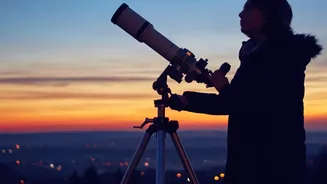
You don't need a telescope to start this journey. Your own eyes are the best tool to learn the basic layout of the sky. A simple pair of binoculars can enhance the view, bringing moon craters and clusters like the Pleiades into sharper focus. For identifying what you're seeing, stargazing apps can be invaluable. Apps like SkyView, Star Walk 2, and Stellarium use your phone's GPS and compass to show you a real-time map of the sky. You just point your phone at a bright object, and any app will identify it for you. For a uniquely Indian perspective, many apps show constellations with their traditional Indian names.