







An Accidental Discovery in Gediz Vallis
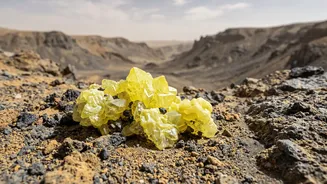
The discovery happened by pure chance. In 2024, as the nearly 900-kilogram Curiosity rover drove across the Martian surface, its wheels rolled over an unassuming rock and broke it open. Inside, instead of the typical rust-coloured dust, were pale yellow
crystals. Mission scientists were astonished. While Mars is known to be rich in sulphur-bearing minerals called sulphates—which form when salty water evaporates—this was different. This was 'native' or elemental sulphur, unbonded to oxygen, a form never before definitively identified on the Red Planet. The find was not an isolated one; the rover soon found an entire field of these light-coloured, sulphur-bearing stones scattered across the landscape.
What is Gediz Vallis?
The discovery was made in Gediz Vallis, a channel carved into the base of the 5-kilometre-tall Mount Sharp, which sits inside the vast Gale Crater. Curiosity has been ascending this mountain since 2014, reading the rock layers like chapters in a history book. Gediz Vallis is particularly interesting to scientists because it was likely formed by large debris flows of rock and water billions of years ago. It represents a later, wetter period in Mars' history, a time when the planet's climate was transitioning to the dry, cold world we see today. By studying this channel, scientists hope to understand what the Martian environment was like just as its rivers and lakes were disappearing.
A Geological Puzzle
The presence of pure sulphur presents a fascinating puzzle. On Earth, large deposits of native sulphur are typically formed through processes involving intense heat, such as at volcanic vents or hot springs, or through the action of microbes. However, scientists see no obvious evidence for such high-temperature activity in the immediate vicinity of Gediz Vallis. The purity of the sulphur also suggests it has not been in prolonged contact with liquid water since it formed, which is another clue to the area's arid past. This leaves researchers with a major question: how did this field of pure sulphur form and remain so pristine for what is estimated to be around 3 billion years?
Clues to an Ancient World
While the sulphur is not a direct sign of life, it provides crucial information about the ancient Martian environment. One theory suggests that hydrogen sulphide and sulphur dioxide gases, released by magma deep beneath the surface, reacted with water to form the pure sulphur. Another model proposes that chemical reactions involving dissolved sulphides and other compounds in acidic water could have produced the sulphur crystals at room temperature. Whatever the mechanism, the discovery reveals that Mars had a more complex and diverse chemical cycle than previously known. It points to a past where different kinds of water-based environments existed, some of which could have been habitable for certain types of microbes that thrive in acidic, sulphur-rich conditions on Earth.
Future Exploration and Construction?
Beyond its scientific value for understanding Mars' past, the discovery has practical implications for future human exploration. Sulphur is an incredibly useful element. Some experts have noted that pure sulphur, mixed with Martian sand, could be heated to create a form of 'Martian concrete'. This would allow future astronauts to build structures using materials found directly on the planet—a concept known as in-situ resource utilization (ISRU). Having access to readily available building materials would be a significant step toward making a human presence on Mars more sustainable. The discovery of this sulphur field, therefore, not only rewrites a chapter of Martian history but could also help write the first chapter of our future there.