




The Ultimate Insurance Policy
In the high-stakes world of human spaceflight, there is no room for error. While launching a rocket is complex, ensuring astronauts can escape a launch that goes wrong is arguably even more critical. This is the purpose of the Crew Escape System (CES),
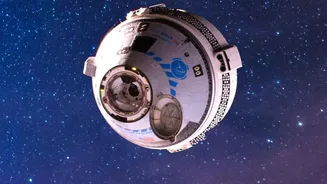
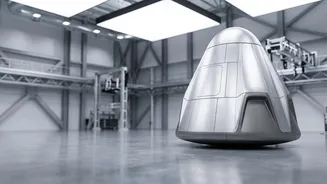
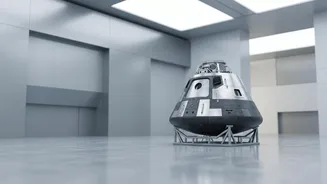
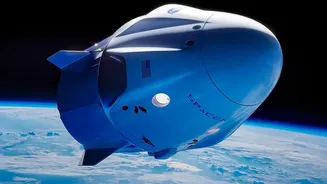
a sophisticated, life-saving technology designed to act as the ultimate insurance policy. The CES is an emergency measure that can pull the crew module—the capsule carrying the astronauts—away from the main rocket at a moment's notice. Whether an issue arises on the launch pad just before liftoff or minutes into the flight, the system must function flawlessly, pulling the crew to a safe distance before deploying parachutes for a gentle landing. For the Gaganyaan programme, ISRO has been exhaustively testing this very system, because when human lives are on the line, success is the only option.
Simulating Disaster to Ensure Success
To validate the Crew Escape System, ISRO has planned a series of complex trials known as abort tests. These tests are designed to simulate emergencies at various stages of the launch sequence. The first was the Pad Abort Test (PAT), successfully conducted in 2018. This test demonstrated the system's ability to safely recover the crew module if an emergency occurs right on the launch pad. The vehicle soared to an altitude of 2.7 km before splashing down in the Bay of Bengal. More recently, the focus has shifted to in-flight abort scenarios. The Test Vehicle Abort Mission-1 (TV-D1) in late 2023 was a crucial step, testing the escape system at a high altitude and transonic speed. After a brief hold due to an engine anomaly, the test proceeded successfully, with the crew module separating and being recovered by the Indian Navy. These demonstrations are part of a larger series of four abort missions designed to prove the system works under all conceivable flight conditions.
The Mechanics of a High-Speed Escape
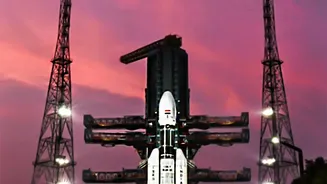
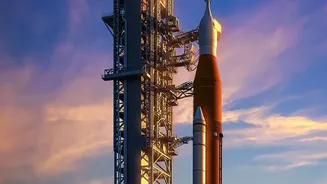
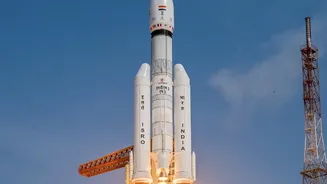
The Crew Escape System is a marvel of engineering, built for one purpose: speed. It consists of a series of powerful, quick-acting solid motors that are designed to ignite in a split second. In an emergency, these motors fire with immense force, pulling the entire crew module away from the much larger launch vehicle. The system has to be powerful enough to overcome the rocket's upward thrust but also controlled enough to ensure the astronauts inside are not subjected to dangerous g-forces. After the module is a safe distance away, the escape system jettisons itself, and the next critical phase begins: deceleration. Significant progress has been made on these systems, with five types of escape motors having successfully completed static testing. All the structures and propulsion stages for the Human Rated Launch Vehicle (HLVM3) have also completed ground testing, bringing the mission closer to its uncrewed flight.
From Freefall to a Gentle Splashdown
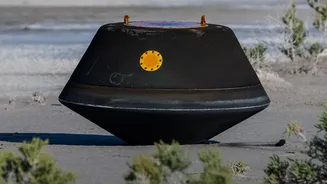
Once the crew module is clear of the rocket, it's a long way down. Ensuring a safe landing is the job of a complex, multi-stage parachute system. The entire sequence involves a total of 10 parachutes of different types. It begins with smaller drogue parachutes that deploy to stabilise the module and begin slowing its descent. This is followed by pilot chutes that pull out the three main parachutes. These massive main parachutes are what ultimately reduce the module's speed to a safe level for a splashdown in the ocean. ISRO has conducted several Integrated Air Drop Tests (IADT) to validate this entire sequence, using Indian Air Force aircraft to drop a simulated crew module from altitude to test the parachute deployment in real-world conditions. These tests are performed in collaboration with the DRDO, Indian Air Force, and Navy, highlighting the national effort behind Gaganyaan.
The Road to India's First Crewed Flight
Every successful test brings India one step closer to launching its own astronauts, a feat achieved by only three other nations. With the abort systems undergoing rigorous validation, the next major milestones are the uncrewed orbital flights. The first of these, Gaganyaan-1 (G1), is scheduled for late 2026 and will be a full dress rehearsal without astronauts. It will carry Vyommitra, a humanoid robot, to simulate human functions and test the Environmental Control and Life Support System (ECLSS). Following one or two more uncrewed flights, the first crewed mission is anticipated in 2027, which will carry three Indian astronauts into a 400 km orbit for up to three days. The astronaut candidates have already completed generic training in Russia and are now undergoing mission-specific training in Bengaluru. As ISRO ticks off each validation test, it's not just testing hardware; it's building a foundation of safety and confidence for a landmark moment in India's history.