






Your Feet Are the Foundation
Before you touch any other setting, your first move should be to get your feet right. Your feet are the foundation of your posture, and if they aren't properly supported, a chain reaction of misalignment can travel up your body. When your feet dangle
or rest awkwardly, your leg muscles are constantly engaged, restricting blood flow and putting strain on your lower back. This instability forces your spine to compensate, often leading to the familiar aches in your lower back, shoulders, and neck. Proper foot support is the anchor that allows the rest of your body to fall into a healthy, neutral position. Think of it as building a house; you have to start with a solid, level foundation.
Step 1: Set Chair Height for Your Legs
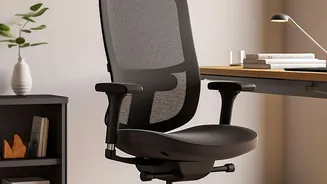
The primary goal is to get your feet flat on the floor. Stand in front of your chair and adjust the seat height until the highest point of the cushion is just below your kneecap. Now, sit down properly, with your back against the backrest. Your feet should rest firmly on the floor. Your thighs should be roughly parallel to the ground, with your knees bent at or slightly more open than 90 degrees, ideally with your hips level with or slightly above your knees. If your knees are pointing up towards the ceiling, your chair is too low. If your feet are dangling, it's too high. This single adjustment correctly distributes your body weight and relieves pressure on your spine.
Step 2: Align with Your Work Surface
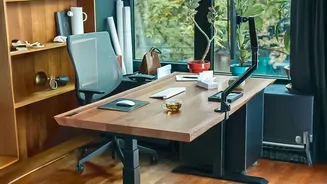
Once your lower body is set, it's time to align your upper body with your desk or keyboard. The goal here is to have your elbows at a roughly 90-degree angle when your hands are on the keyboard. Sit close to your desk with your shoulders relaxed. Let your arms hang naturally at your sides, then bend your elbows to a 90-degree angle. Your hands should now hover just over your keyboard. If you have to hunch your shoulders to reach your desk, your work surface is too high. If you are reaching up, your work surface is also too high relative to your chair. In this scenario, you should raise your chair until your elbows are at the correct height relative to the desk.
What If My Feet Don't Reach?
This is a common problem, especially if you've had to raise your chair to match a high, non-adjustable desk. If your feet are now dangling after making the correct arm-level adjustment, you need a footrest. A footrest bridges the gap, providing the stable foundation your body needs and preventing pressure on the back of your thighs. You don't need a fancy gadget; a stack of sturdy books or a small stool can work in a pinch. The key is that your feet must be fully supported, allowing your thighs to remain parallel to the floor. This ensures you don't have to choose between good arm posture and good leg posture.
Fine-Tuning for Total Comfort
With the height established, you can dial in the other settings. First, check your seat depth. When sitting all the way back, you should be able to fit two to three fingers between the front edge of the seat and the back of your knees. This prevents the seat from cutting off circulation. Next, adjust the lumbar support so it fits into the natural curve of your lower back, providing firm but comfortable pressure. Finally, set your armrests. They should be at a height where they just barely touch your elbows when your arms are bent at 90 degrees, allowing your shoulders to remain relaxed. If the armrests force you to shrug your shoulders, they are too high and it may be better to lower them or remove them entirely.