





A Tale of Two Planets
Around four billion years ago, early Mars and early Earth were remarkably similar. Evidence strongly suggests that liquid water flowed across the Martian surface, carving out valleys and filling vast basins that may have been oceans. This would have required
a much denser atmosphere than the thin envelope of gas that remains today—one capable of trapping heat and maintaining liquid water. Like Earth, this early Mars was protected by a global magnetic field, a crucial ingredient for nurturing a habitable environment. This invisible shield was generated by a dynamo, a flow of molten metal within the planet's core. This shield was the key to holding onto its atmosphere and water.
The Dynamo's Demise
The critical difference between Earth and Mars is size. Mars is significantly smaller, which means it had less internal heat to begin with and cooled down much faster. A planet's magnetic field is generated by the churning of a liquid outer core around a solid inner core. As Mars’s interior cooled, this churning motion, known as convection, slowed and eventually stopped altogether. Scientists believe this planetary dynamo flickered out around 4.1 billion years ago, although some evidence suggests it may have sputtered on for a few hundred million years longer in some regions before dying completely. Without its dynamo, Mars's global magnetic field vanished, leaving it exposed and vulnerable.
Enter the Solar Wind
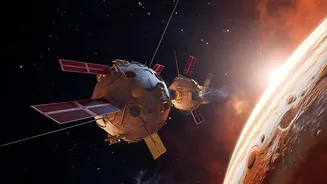
The Sun constantly spews out a stream of charged particles called the solar wind, which travels at speeds of around a million miles per hour. Earth's robust magnetic field deflects the vast majority of this onslaught, protecting our atmosphere. But once Mars lost its shield, the solar wind was able to slam directly into its upper atmosphere. This relentless bombardment, observed in detail by NASA’s MAVEN (Mars Atmosphere and Volatile Evolution) mission, began to strip away atmospheric particles. The energetic particles of the solar wind imparted enough energy to atmospheric gases to knock them out of Mars's gravitational pull and send them hurtling into space.
A World Stripped Bare
The process was devastatingly effective. Over hundreds of millions of years, the solar wind stripped away the bulk of the Martian atmosphere. This process was likely accelerated in the early solar system, when the young Sun was more active and produced an even more intense solar wind. As the atmosphere thinned, the air pressure dropped precipitously. Liquid water on the surface became unstable, boiling away in the low pressure and escaping into space as vapor, where it too was stripped away by the solar wind. The planet’s climate transformed, turning from warm and wet to the frigid, dry desert we know today. Data from MAVEN has allowed scientists to calculate the rate of atmospheric loss, confirming that this solar stripping was the primary driver of Mars's dramatic climate change.
Clues Left Behind
While the global magnetic field is gone, pockets of magnetized rock remain in Mars's southern hemisphere, a fossil record of the ancient dynamo. These 'crustal fields' are remnants of a time when the entire planet was protected. Spacecraft like MAVEN and China's Tianwen-1 have studied how the solar wind interacts with what's left of the atmosphere. They have observed atmospheric ions being carried away in plumes and have even seen how the solar wind can generate giant, rolling waves at the edge of the atmosphere that help carry plasma clouds into space. These direct observations provide the crucial evidence linking the loss of the magnetic field to the stripping of the atmosphere, solving a key piece of the puzzle of Mars's past.