





The Legend of the Seven Pagodas
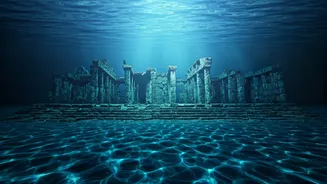
The magnificent Shore Temple at Mahabalipuram, a UNESCO World Heritage site, has stood against the Bay of Bengal for over a thousand years. But local lore, passed down through generations of fishermen and recorded by early European travellers, insists
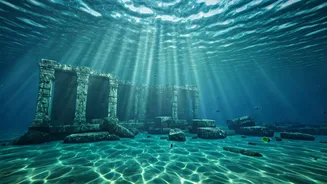
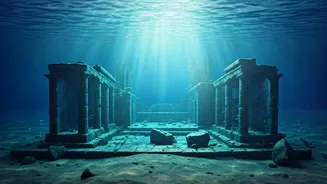
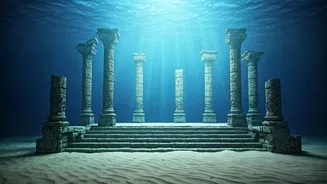
it was not always alone. The legend speaks of a grand temple complex of seven pagodas, six of which were claimed by the ocean due to the jealousy of the gods, leaving only the Shore Temple as a solitary survivor. For centuries, this was considered just a captivating story—a myth to explain the grandeur of the Pallava-era monuments. Fishermen would speak of glimpsing glittering structures beneath the waves on clear days, but concrete proof of this submerged city remained elusive.
A Tsunami Reveals a Glimpse
The devastating 2004 Indian Ocean tsunami brought unexpected clues. As the sea violently receded from the Mahabalipuram coast by as much as 500 meters, eyewitnesses reported seeing a long, straight row of large rocks and structures emerge from the seabed before the waves crashed back ashore. This event, while catastrophic, washed away centuries of sediment and briefly exposed what lay hidden. The tsunami's retreat also uncovered previously buried statues and structures on the beach, including a large stone lion, which archaeologists dated to the 7th century. This startling revelation reignited intense scientific and popular interest, transforming the legend from a fanciful tale into a testable hypothesis.
Seeing Beneath the Waves with Sonar
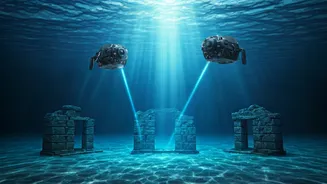
Following the tsunami, the Archaeological Survey of India (ASI) and the Indian Navy launched joint expeditions to investigate these claims. The key to their search was advanced sonar technology. Sonar, which stands for Sound Navigation and Ranging, works by sending pulses of sound waves down into the water. These sound waves bounce off the seafloor and any objects on it, returning to a detector. By measuring the time it takes for these echoes to return, scientists can create a detailed, three-dimensional map of the seabed. This is particularly effective in murky coastal waters where visibility for divers is poor. Technologies like side-scan sonar and multibeam echosounders can reveal the shape, size, and texture of submerged objects with remarkable clarity, essentially allowing researchers to 'see' through the water and sediment.
What the Underwater Scans Found
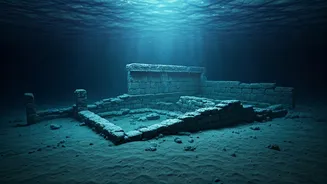
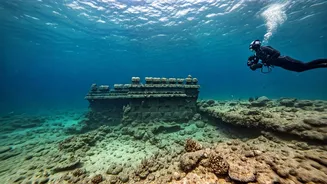
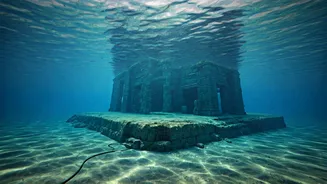
The initial sonar surveys in 2005 were fruitful. They confirmed that the row of rocks seen during the tsunami was part of a 70-meter-long man-made wall. The scans also revealed the remains of two other submerged temples and a cave temple, all within 500 meters of the coast. Subsequent explorations by institutions like the National Institute of Oceanography (NIO) have expanded on these findings. They have mapped numerous man-made structures at depths of 5 to 8 meters, including more walls, scattered dressed stone blocks with chisel marks, and what appears to be a flight of stairs. While many structures are covered in thick marine growth, their layout suggests they were once part of a larger building complex. Some findings have even been dated to the Sangam period, suggesting a history even older than the Pallava dynasty.
The Next Chapter: High-Tech Exploration
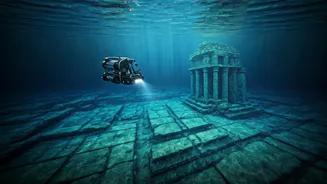
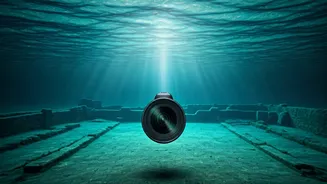
The quest continues to evolve. In recent times, the ASI's Underwater Archaeology Wing has resumed explorations using even more sophisticated technology. A key new tool is the Remotely Operated Vehicle (ROV). This unmanned submarine, equipped with high-resolution cameras, can explore deeper and more challenging environments than divers safely can. The ROV provides crystal-clear video footage of the ruins without disturbing the delicate archaeological site. This new phase of fieldwork aims to build on the earlier sonar maps, providing visual documentation that can help archaeologists understand the function and significance of these submerged structures and solve the riddle of Mahabalipuram's lost pagodas.