




Titan: An Earth-Like Oddity
In our solar system, Titan is a world of incredible intrigue. It is the only moon known to possess a thick atmosphere, even denser than Earth's, and the only other body besides our own with stable liquid on its surface. But this is not a world of water.
On Titan, where surface temperatures hover around a frigid -179 degrees Celsius, the rivers, lakes, and seas are filled with liquid methane and ethane. This bizarre world has an active weather system, complete with methane clouds, rain, and vast fields of organic sand dunes. Scientists are fascinated by Titan because it is rich in complex, carbon-based molecules. This chemical soup, combined with the presence of a subsurface liquid water ocean, makes it a unique natural laboratory for studying prebiotic chemistry—the chemical steps that may have occurred on early Earth before life emerged.
The Challenge of Exploration
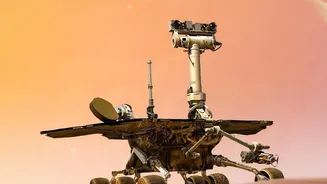
Exploring such a world presents immense challenges. The Huygens probe, which made a historic landing on Titan in 2005, provided a tantalizing glimpse but was stationary. A traditional wheeled rover, like those on Mars, would be severely limited. Titan’s surface is a varied landscape of dunes and broken, icy ground, making long-distance travel difficult and slow. The most compelling scientific targets are spread across vast distances. To truly understand Titan, scientists need to move between different geological settings—from the organic-rich dunes to the floor of an impact crater where liquid water may have once pooled. A stationary lander could only tell part of the story, and a rover might take many years to cover the necessary ground, if it could navigate the terrain at all. This is where a different approach was needed.
The Advantage of Taking Flight
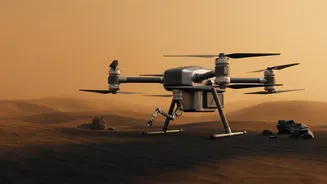
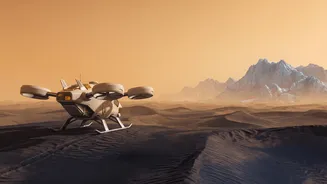
Dragonfly's genius lies in its ability to fly. It is a dual-quadcopter, essentially an octocopter, designed to take advantage of Titan's unique conditions. The moon's thick atmosphere and low gravity (about one-seventh of Earth's) make powered flight incredibly efficient. What would be a monumental trek for a rover becomes a short hop for Dragonfly. In just tens of minutes, it can cover several kilometres, a distance that could take a Mars rover an entire day or more. This mobility is a game-changer. Instead of being confined to a single landing site, Dragonfly will operate as a relocatable science lab. It will fly to a new location, land, conduct its experiments over several days, and then fly to the next point of interest, allowing it to sample dozens of diverse locations during its multi-year mission.
Science on the Wing
This ability to travel unlocks a new dimension of planetary science. Dragonfly's primary mission is to investigate Titan's habitability and search for chemical clues about the origin of life. The mission plan involves starting in a dune field recently named Ahmakiq Undae and making a series of flights toward Selk crater. This 90-kilometre-wide crater is a high-priority target because the heat from the ancient impact is believed to have melted the local water ice, creating a temporary pool where liquid water and complex organic materials could have mixed for thousands of years. By sampling materials from both the organic dunes and the area affected by this liquid water event, Dragonfly can analyse how far prebiotic chemistry has progressed in different environments. It will be the first mission to explore the surface of Titan in detail, answering questions that orbiting spacecraft like Cassini could only pose.