



Why Go Big in a Small Space?
It sounds like a design contradiction, but the logic is surprisingly simple. While multiple small frames can make a wall feel cluttered and fragmented, a single large artwork creates a powerful focal point. This strategy reduces visual 'noise' by giving
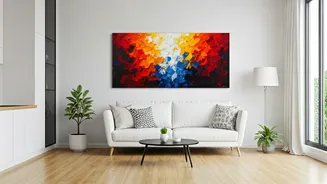
the eye one clear place to rest, making the entire room feel calmer and more organised. An oversized piece tricks the eye, making the wall it hangs on seem more expansive. Instead of highlighting a room's limited dimensions with scattered decor, a statement artwork establishes a sense of scale and intention, turning a plain wall into the room's architecture.
Choose Your Statement Piece
The term 'big art' doesn't just mean a massive canvas painting. In an Indian context, this could be a large, framed textile like a Kalamkari or a hand-woven Ikat fabric. It could be a vibrant Pichwai or Madhubani painting that introduces a pop of colour to a neutral room. For modern minimalist interiors, the clean geometric lines of Warli art can add cultural depth without overwhelming the space. Consider the art's content as well. Landscape scenes or abstract pieces with a sense of depth can act like a window, making the room feel deeper. Art with plenty of negative or light-coloured space also helps maintain an airy feel.
The Rules of Placement
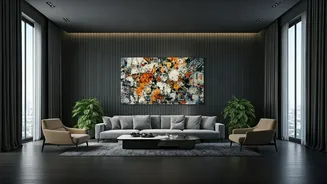
Where you hang your art is just as important as the piece itself. The most common and effective placement is on the wall above the main sofa in the living room. As a general rule, the artwork should be about two-thirds the width of the furniture it hangs above. This ensures the art feels anchored and proportionate. The centre of the artwork should be at eye level, which is typically around 145-155 cm from the floor. When hanging it above furniture, leave about 15-25 cm of space between the top of the sofa or console and the bottom of the frame to create a visual connection.
The Art of Illusion
You can use the orientation of your art to manipulate the feel of the room. A vertical, portrait-oriented piece will draw the eye upward, creating the illusion of higher ceilings—perfect for many modern apartments. Conversely, a wide, horizontal or panoramic piece can make a narrow room feel wider. The colour palette of your chosen art also plays a role. Cool tones like soft blues and greens tend to recede visually, making a wall feel further away. Don't be afraid to hang art in unexpected places like a narrow hallway or entryway to make those transitional spaces feel more intentional and spacious.
Create Balance in the Room
Once you have a statement piece, let it be the star. The key to making big art work in a small space is to keep the surrounding decor relatively simple. If your art is vibrant and complex, balance it with neutral walls and simple furniture. You don't need to match every colour in the painting with your cushions and throws; instead, pick one or two accent colours from the art and echo them subtly in the room. By allowing the artwork to be the main focal point, the rest of the room can remain uncluttered, which enhances the overall feeling of spaciousness and prevents the interior from feeling chaotic or over-planned.