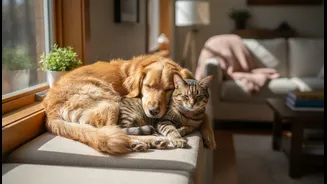









Beyond a Simple Truce
For decades, the primary goal for owners of both cats and dogs was simple: prevent fights. The new thinking, however, goes much deeper. It’s not just about avoiding conflict, but about understanding the quality of the life they share. Experts are now
encouraging owners to look beyond peaceful coexistence and ask more nuanced questions. Are the animals just tolerating each other, or are they forming a genuine social bond? The focus is shifting from simple management to actively enriching their shared environment. This involves recognizing that a cat is not a small dog; they are distinct species with different evolutionary backgrounds, social structures, and needs. A dog, a pack animal, often seeks social interaction, while a cat, descended from solitary hunters, may need the ability to isolate itself to feel secure.
Decoding Cross-Species Communication
One of the biggest hurdles is that cats and dogs speak different languages. A wagging tail on a dog often signals excitement, while a twitching or lashing tail on a cat can mean agitation. Research shows that while these signals can be misinterpreted, dogs and cats living together can learn to read each other's cues. A 2020 study found that despite different body languages, most cohabiting pets showed relaxed responses to each other's approaches. Dogs, for instance, often respond amicably when a cat approaches with its tail up—a friendly feline signal. Understanding these signals is no longer just for the animals; owners are now seen as crucial interpreters. Recognizing subtle signs of stress, like a dog showing 'whale eye' (the whites of its eyes) or a cat flattening its ears, allows the owner to intervene before tension escalates.
The Home as a Shared Territory
A harmonious multi-pet home is not just about the animals, but about the space they inhabit. The modern approach to ownership emphasizes creating an environment that respects the needs of both species. This goes beyond simply providing two food bowls. For cats, vertical space is crucial; having access to cat trees, shelves, or high perches provides a safe retreat where they can observe the dog from a distance without feeling threatened. This sense of control is paramount for a cat's comfort. Similarly, each animal needs its own designated safe space for resources like food, water, and, for cats, litter boxes. Competition over these resources, or even an owner's attention, can be a major source of conflict. Ensuring that each pet has a secure place to eat and rest without being harassed is a cornerstone of preventing territorial disputes.
The Owner as a Social Mediator
Simple ownership is a thing of the past; today’s multi-pet owner must be an active mediator. This means managing interactions, not forcing them, and using positive reinforcement to build good associations. Rewarding calm behaviour when the animals are near each other helps them associate the other's presence with positive outcomes, like treats or praise. Conversely, allowing a dog to constantly chase the cat can create a cycle of fear and anxiety that is hard to break. The initial introduction period is critical and should be done slowly, often starting with scent-swapping (exchanging blankets or toys) before allowing supervised visual contact. Ultimately, the goal isn't necessarily for them to become best friends who cuddle constantly. Many successful relationships are built on mutual respect and amicable avoidance. The owner's role is to facilitate the best possible relationship for their specific pets' personalities.