



The Challenge of Too Much Data
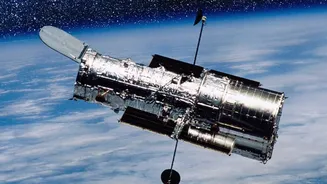
For decades, NASA has launched telescopes, probes, and rovers that have sent back a treasure trove of information about our planet, the solar system, and the universe beyond. Missions observing Earth science alone have generated archives projected to
grow well beyond 60 petabytes. To put that in perspective, one petabyte is equivalent to about 500 billion pages of standard text. The sheer volume of this data has overwhelmed the traditional methods of human analysis. Scientists can't possibly look at every image or analyze every data point, meaning potential discoveries could remain hidden for years, or even forever, within these massive digital archives.
A New Kind of Research Assistant
To tackle this data deluge, NASA is turning to a powerful new form of artificial intelligence: foundation models. These are large, adaptable AI systems trained on vast datasets. Think of them not as a simple tool for one task, but as a highly skilled research assistant that can learn and be adapted for many different scientific jobs with minimal extra training. In partnership with companies like IBM, NASA is developing a suite of these models, each specialized for a different area of science, such as heliophysics (the study of the Sun) and planetary science. The goal is to embed NASA's scientific expertise directly into these AI models, allowing them to spot patterns, identify anomalies, and flag data worthy of human attention.
AI Navigating Other Worlds
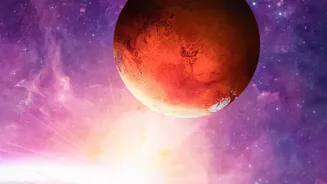
One of the most impressive applications of AI is in the autonomous exploration of Mars. Because of the communication delay between Earth and Mars, rovers can't be manually controlled in real time. NASA's Perseverance and Curiosity rovers use AI to navigate the treacherous Martian terrain on their own. The Perseverance rover, for example, has performed the vast majority of its driving autonomously. It uses its cameras to create a 3D map of the terrain, identifies potential hazards like large rocks or steep slopes, and then plots the safest and most efficient path forward, all without waiting for instructions from Earth. This allows the rovers to cover more ground and conduct more science than would otherwise be possible. AI also helps the rovers be better scientists, with instruments that can autonomously select rock targets for chemical analysis to search for signs of ancient life.
Uncovering the Secrets of the Cosmos
Beyond Mars, AI is revolutionizing how we find and study distant objects. Machine learning systems are being used to sift through data from space telescopes like Kepler and TESS, which monitor millions of stars for the telltale dip in brightness that indicates a planet is passing in front of it. One AI system called ExoMiner analyzed data from the Kepler telescope and successfully identified 301 previously unknown exoplanets. Another tool, known as RAVEN, recently confirmed over 100 exoplanets, including rare worlds in unexpected places. AI is also being trained to predict cosmic events, such as solar flares that can impact satellites and power grids on Earth, by analyzing years of observations from solar observatories. These AI models can spot faint signals in the data that a human might miss, accelerating the pace of discovery.
A Human-AI Partnership
It's important to understand that AI is not replacing NASA's scientists. Instead, it's augmenting their abilities, creating a powerful human-AI partnership. The AI handles the laborious task of sifting through petabytes of raw data, a job that is tedious and time-consuming for humans. This frees up the agency's experts to focus on what they do best: interpreting the most interesting findings, developing new hypotheses, and asking the big-picture questions that drive science forward. By automating data analysis and mission planning, AI is making scientific workflows more efficient and fostering collaboration across different missions and disciplines. This new era of exploration isn't about machines taking over; it's about giving human ingenuity a powerful new tool to unlock the universe's greatest mysteries.