




A Breakthrough Braking System
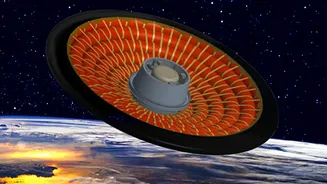
The concept sounds like science fiction, but it is a game-changing technology that has been in development for over a decade. Known as a Hypersonic Inflatable Aerodynamic Decelerator, or HIAD, this technology is designed to solve one of the biggest constraints
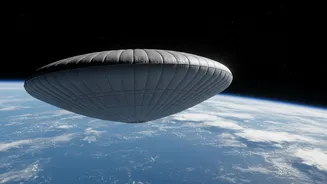
in space exploration: the size of the heat shield. Traditional heat shields are rigid and must fit within the nose cone, or payload fairing, of a rocket. This physical limit restricts the size and weight of what we can land on other planets. An inflatable shield, however, can be packed into a small volume for launch and then deployed to a massive scale before entering an atmosphere. This allows it to create far more drag, slowing a spacecraft down earlier and more gently.
How an Inflatable Shield Survives
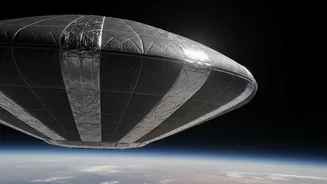
An inflatable structure might seem ill-suited to survive temperatures that can reach nearly 3,000 degrees Fahrenheit, but the system is a marvel of materials science. The core is an inflatable structure, often a series of stacked rings or tori made from a synthetic polymer that is, by weight, significantly stronger than steel. This provides the rigid shape needed when inflated. This structure is then covered by a flexible thermal protection system. The outermost layer is a cloth woven from ceramic silicon carbide fibers, which can withstand the extreme heat of reentry. Beneath this are layers of high-tech insulation that keep the inflatable structure from melting. The entire system works together to both slow the vehicle and shield it from the inferno of atmospheric entry.
Bigger Payloads for Bolder Missions
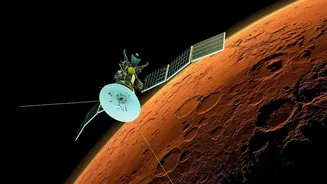
The primary advantage of HIAD technology is its scalability. Because it isn't limited by the rocket's fairing, it can be much larger than a rigid shield. A bigger shield means more drag, which is crucial for planets with thin atmospheres, like Mars. The Martian atmosphere is too thin to effectively slow down heavy spacecraft with conventional shields, limiting landings to lower elevations. With a HIAD, missions could land heavier payloads—like habitats, ascent vehicles for return journeys, and larger robotic explorers—at higher-altitude locations that are currently out of reach but scientifically interesting. This opens up new possibilities for both robotic and future human missions to the Red Planet.
Proven in the Field
This isn't just a theoretical concept. NASA has been successfully testing the technology through a series of missions. The culmination of this was the Low-Earth Orbit Flight Test of an Inflatable Decelerator (LOFTID) in November 2022. Launched as a secondary payload, the 6-meter (about 20-foot) diameter shield inflated in orbit and successfully re-entered Earth's atmosphere at speeds over 18,000 miles per hour. It survived the intense heat and pressure, splashing down safely in the Pacific Ocean where it was recovered. The test was declared a huge success, proving that the technology works in real-world conditions and providing invaluable data for future designs.
The Future of Planetary Landings
The success of inflatable heat shield technology paves the way for a new era of exploration. Beyond Mars, these systems could enable ambitious missions to Venus and Saturn's moon Titan, both of which have thick atmospheres. The technology also has applications closer to home, such as recovering spent rocket stages for reuse or returning large quantities of cargo or manufactured goods from the International Space Station. European agencies are also developing their own inflatable shield concepts, highlighting the global importance of this innovation. What started as an out-of-the-box idea is now a demonstrated and critical technology that will help humanity take its next giant leaps in exploring the solar system.