





What Is Opposition?
In celestial terms, 'opposition' is all about alignment. On October 4, 2026, Earth will pass directly between the Sun and Saturn. This places the ringed planet on the opposite side of the sky from the Sun. Think of it like a celestial full moon; the face
of Saturn we see will be fully illuminated by sunlight, making it appear exceptionally bright and large from our perspective. This alignment means Saturn will rise in the east around sunset, glide across the sky all night long, and set in the west around sunrise, making it visible for the entire night.
The Best Nights To Look
The peak of opposition occurs on Sunday, October 4, 2026. For observers in India, Saturn will rise around 6:11 pm, reach its highest point in the sky around midnight, and set the next morning around 6:23 am on October 5. This gives you a generous 12-hour window to find it. However, you don't need to wait for the exact date. The weeks surrounding October 4 are also excellent for viewing, as Saturn moves slowly across our sky. This extended period provides plenty of chances to catch a clear night for stargazing.
Finding Saturn In The Night Sky
You don't need to be an expert astronomer to find Saturn. After sunset, simply look towards the eastern sky. Saturn will be visible to the naked eye as a bright, steady, yellowish point of light. Unlike stars that twinkle, planets tend to shine with a more constant glow. This month, Saturn will be located in the constellation Cetus, the Whale, just below the large asterism known as the Great Square of Pegasus. If you have a stargazing app on your phone, it can point you in the right direction in seconds.
What You Can Expect to See
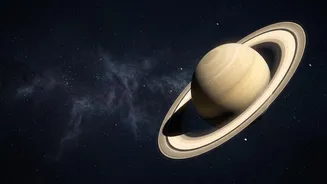
While Saturn is easily spotted without any equipment, its true magic is revealed through optical aid. Even a pair of high-powered binoculars might show the planet as a slightly elongated dot, hinting at the rings. To truly resolve the rings as a distinct structure separate from the planet, you'll need a telescope. A small backyard telescope with at least 50x magnification should be enough to reveal the iconic rings, which will appear as a glowing oval around a golden disk. With a larger telescope of around 6 inches on a clear night, you might even spot the Cassini Division—a dark gap between the main rings—or Saturn's largest moon, Titan, which will look like a faint star nearby.
A Special Year for the Rings
This year's opposition is particularly special. In 2025, Saturn's rings appeared almost edge-on from our perspective, making them nearly invisible. Now, they are beginning to open up again. In October 2026, the rings will be tilted about 7.5 degrees towards us, making them easily visible once more and offering a much more impressive sight. This is also when the 'opposition surge' or Seeliger effect occurs, a phenomenon where the icy particles of the rings reflect sunlight directly back to us, causing them to appear noticeably brighter for a few days around October 4.