





Sailing on Sunbeams
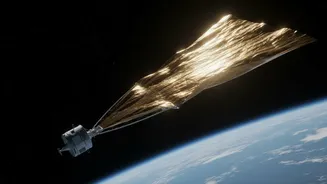
The concept of a solar sail sounds magical, but it’s grounded in fundamental physics. Light is made of particles called photons. While photons have no mass, they carry momentum. When a photon from the sun strikes a highly reflective, mirror-like surface
and bounces off, it transfers a tiny amount of that momentum, giving the surface a minuscule push. Think of it like a continuous stream of microscopic billiard balls hitting a target. Individually, the push is negligible—about the weight of a single grain of sugar on the palm of your hand. But in the vacuum of space, with no friction and a constant stream of sunlight, this gentle, unending pressure can gradually accelerate a spacecraft to enormous speeds. Unlike a traditional sailboat that tacks against the wind, a solar sail can also angle itself relative to the sun to steer, allowing it to move toward or away from the sun and navigate complex orbits.
The Current Proving Ground
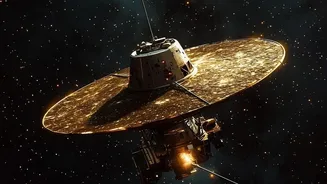
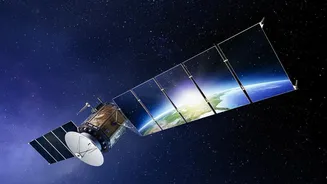
The latest and most ambitious test of this technology is NASA's Advanced Composite Solar Sail System, or ACS3. Launched in April 2024, ACS3 is a technology demonstration packed into a small satellite roughly the size of a toaster oven. Its primary mission is not just to sail, but to test a new generation of lightweight booms made from advanced composite materials. These booms are crucial because future sails will need to be massive to be effective, and the structure holding them must be both incredibly light and strong enough to keep the sail taut. In late 2024, the mission achieved a major milestone by successfully unfurling its 80-square-meter sail—about the size of a small apartment. While a minor snag was reported with one boom, the deployment successfully proved the viability of the new materials, paving the way for even larger designs.
The Fuel-Free Advantage
The biggest advantage of solar sailing is the elimination of propellant. Traditional rockets are mostly fuel by weight, which makes them incredibly expensive to launch and limits their operational lifespan. A solar sail spacecraft, by contrast, carries no fuel. This dramatically reduces launch mass, freeing up space and budget for more scientific instruments. Furthermore, chemical rockets provide a powerful but brief burst of thrust, after which they coast. A solar sail provides continuous, non-stop acceleration. Over months and years, a solar sail can achieve speeds that would be impossible for a conventional rocket on a similar budget. This constant propulsion makes solar sails an ideal candidate for long-duration missions that require sustained travel over vast cosmic distances.
Charting a Course for the Stars
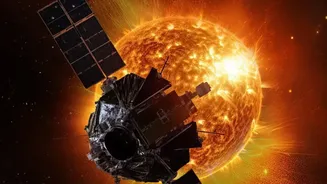
Solar sails are not designed for quick trips to the Moon or for escaping Earth's gravity directly. Their strength lies in the long game. The technology opens up new possibilities for missions that were previously impractical. For example, a solar sail could 'hover' at a point between the Earth and Sun, providing a stable platform for monitoring solar storms and giving us earlier warnings of potentially disruptive space weather. They are also perfectly suited for missions to survey near-Earth asteroids or for visiting multiple targets in a single trip. With the successful tests of composite booms from missions like ACS3, engineers are already designing future sails that could be as large as a basketball court or even bigger. These massive sails could one day propel probes to the outer planets in a fraction of the time it currently takes, and are even considered one of our most promising technologies for eventual interstellar travel.