




Moving Beyond the 'Goldilocks' Zone
Scientists have long used the 'habitable zone'—often called the 'Goldilocks zone'—to identify planets where conditions might be just right for life. This zone is the orbital range around a star where a planet is not too hot and not too cold for liquid
water to exist on its surface, a key ingredient for life as we know it. However, some scientists, like Dirk Schulze-Makuch and René Heller, argue this is too Earth-centric. They introduced the concept of 'superhabitable' planets in 2014, proposing that we should look for worlds that could be even more suitable for the emergence and evolution of life than our own. This means looking beyond planets that are simply Earth-like and considering those with characteristics that might offer a superior environment for biology to flourish.
Why a Little Warmer Might Be Better
One of the most surprising ideas behind superhabitability is that the ideal average surface temperature might be slightly warmer than Earth's. Researchers propose an optimal temperature of around 25°C (77°F). Our planet’s vast, cold polar regions and deserts show that large parts of Earth are not ideal for a high density of life. A slightly warmer global average could lead to smaller ice caps and more widespread tropical, moisture-rich conditions. This kind of environment is associated with greater biodiversity on Earth. Think of the Amazon rainforest versus Antarctica; warmth and moisture fuel abundance. A warmer planet with a denser atmosphere could also increase the concentration of gases like oxygen and greenhouse gases, further enhancing conditions for life.
The Right Star for a Stable Climate
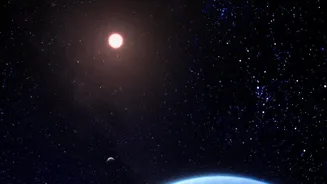
A planet's temperature isn't just about its distance from its star; the type of star matters immensely. Our sun is a G-type star (a yellow dwarf). While it has served us well, it has a finite lifespan, and its brightness changes over billions of years. Scientists believe K-dwarf stars (orange dwarfs) might be better hosts for life. These stars are cooler and less massive than our sun, but they burn their fuel much more slowly and can remain stable for tens of billions of years—far longer than our sun's 10-billion-year lifespan. This incredible stability provides a much longer, more consistent window for complex life to evolve without the threat of a rapidly aging star changing the climate. K-dwarfs also emit less harmful high-energy radiation and have less violent flare activity than the even smaller M-dwarf (red dwarf) stars, striking a 'sweet spot' for habitability.
It's Not Just About the Heat
While temperature is a critical factor, it works in concert with other planetary features to create a superhabitable world. For instance, a planet slightly larger and more massive than Earth—perhaps 1.5 times the size—could have stronger gravity to hold onto a thicker atmosphere, which aids in temperature regulation. Its larger core could generate a more powerful magnetic field, providing better protection from cosmic radiation. The distribution of land and water is also key. A world with many shallow seas and archipelagos, rather than vast deep oceans and large continents, might offer more coastline and aquatic habitats where life often begins and diversifies. In a 2020 study, Schulze-Makuch and his team identified 24 exoplanet candidates that might fit some of these superhabitable criteria, all located more than 100 light-years away.