





The Engine of the Oven
At the heart of every microwave oven is a device called a magnetron. This component, a vacuum tube developed from radar technology, generates high-frequency electromagnetic waves—microwaves. These waves are a type of non-ionizing radiation, similar to
radio waves, and are released into the metal-lined cooking chamber. The metal walls reflect the microwaves, causing them to bounce around and fill the space, ensuring they can reach the food from all angles.
A Dance of Water Molecules
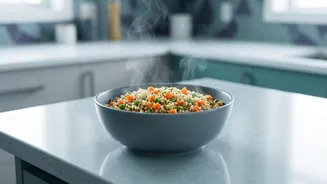
The secret to microwave heating is its effect on water. Food contains water molecules, which are 'polar'—meaning they have a slightly positive end and a slightly negative end, like tiny magnets. When the microwaves flood the oven, their oscillating electric field pulls these water molecules back and forth, causing them to vibrate and rotate rapidly—about 2.5 billion times per second. This frantic molecular dance creates friction between the molecules, which in turn generates heat. This process is known as dielectric heating. It's why foods with high water content, like vegetables or soups, heat up so quickly. Conversely, very dry foods may not heat as effectively.
The 'Inside-Out' Cooking Myth
A common belief is that microwaves cook food from the inside out. This is a myth, though it contains a grain of truth. Unlike a conventional oven that heats food from the exterior via hot air, microwaves penetrate the food's surface. However, this penetration is limited, typically to a depth of about 1 to 1.5 inches. The microwaves deposit energy in these outer layers, causing them to heat up. This heat is then transferred to the food's center through the conventional process of conduction, much like how a pan on a stove heats its contents from the bottom up. So, while microwaves do heat below the surface, they don't magically start at the very center of a thick item. The FDA has also stated that microwaves do not cook food from the 'inside out'.
Explaining Hot and Cold Spots
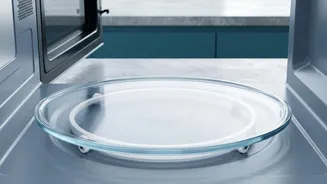
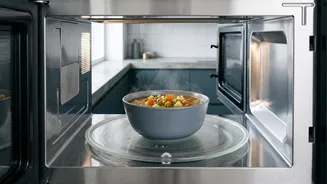
If you've ever found your microwaved meal to be scalding in one area and cool in another, you've experienced 'hot spots'. These occur because the microwaves bouncing around the oven cavity interfere with each other, creating what are known as 'standing waves'. These waves have peaks (antinodes) where the energy is intense, creating hot spots, and valleys (nodes) where there is little energy, resulting in cold spots. This is precisely why most microwave ovens have a rotating turntable. By rotating the food, it ensures that every part passes through both the hot and cold spots, promoting more even cooking.
A Quick Note on Metal
The warning to never put metal in a microwave is there for a good reason. The metal walls of the oven are smooth and designed to reflect microwaves. However, a piece of metal with sharp edges, like a fork or crumpled aluminium foil, can cause problems. The microwaves induce electric currents in the metal, and these charges can build up on any sharp points. This can create a high enough voltage to ionize the surrounding air, resulting in the dramatic sparks you might have accidentally witnessed. These sparks can damage your microwave, so it's best to stick to microwave-safe containers.