







The Cosmic Lighthouses
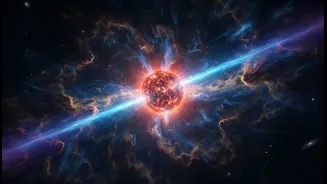
Imagine an object the size of a city containing more mass than our sun, spinning hundreds of times per second. This is a neutron star, the crushed core left behind after a massive star explodes. Some of these neutron stars have intense magnetic fields
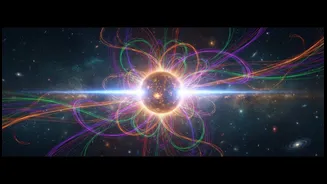
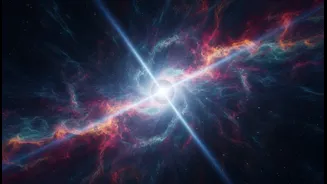
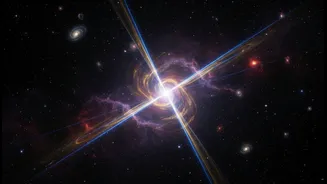
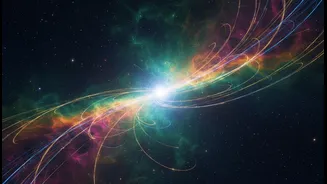
that funnel out powerful beams of radiation. As the star rotates, these beams sweep through space. If one of these beams happens to cross our line of sight, we see a regular pulse of energy. This is a pulsar, and the effect is so regular it’s often called the “lighthouse model.” For decades, this model has been the foundation for understanding these extreme objects that challenge our understanding of physics.
More Than Just a Pulse
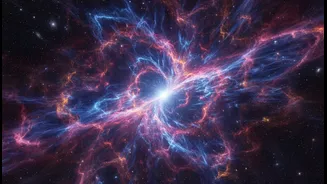
A pulsar’s influence extends far beyond its pulsing beam. These spinning dynamos blast out a torrent of charged particles at nearly the speed of light, an outflow known as a pulsar wind. This wind is not a gentle breeze; it’s a powerful, relativistic force that slams into the surrounding interstellar gas or the remnants of the supernova that created the pulsar. This collision creates a vast, glowing structure called a pulsar wind nebula. The most famous example is the Crab Nebula, powered by a pulsar at its heart. Studying these nebulae is crucial because they are natural laboratories for extreme physics, but their chaotic and complex structures make them incredibly difficult to decipher. Understanding them requires knowing the precise nature of the engine driving them: the pulsar itself.
A New Cartography of the Cosmos
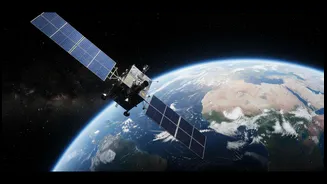
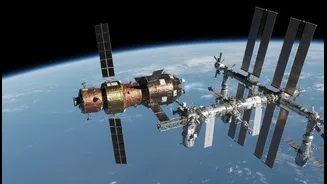
While there isn’t a single NASA project officially named the “Lighthouse Pulsar Map,” the agency's NICER (Neutron star Interior Composition Explorer) mission aboard the International Space Station effectively serves this function. NICER is an X-ray telescope with unprecedented timing precision, able to detect the arrival of X-ray photons from pulsars to within a hundred nanoseconds. This allows scientists to do something revolutionary. By carefully tracking the subtle changes in the X-ray light as the pulsar spins, they can map the hot spots on the star's surface. These spots, where the magnetic field lines plunge into the star, are the source of the high-energy radiation and are far more complex than the simple two-pole model once suggested.
Illuminating the Unseen Winds
This is where the map becomes a key. By precisely mapping the size, shape, and location of the hot spots on the pulsar's surface, scientists can build a much more accurate model of its magnetic field. Since this magnetic field is what accelerates the particles that form the pulsar wind, a better map of the cause leads directly to a better understanding of the effect. This allows astrophysicists to create more sophisticated simulations of how the wind flows out and interacts with its surroundings to form the nebula. It helps explain the jets, tori, and other complex features seen in nebulae like the Crab, connecting the tiny, spinning engine to the vast, glowing structure it powers. NICER's data is redrawing the textbook image of pulsars, showing their magnetic fields are more complex than previously thought.
Hype vs. Horizon
So, can this work improve our understanding without cosmic overstatement? The answer is a resounding yes. The temptation in space science is to announce groundbreaking, paradigm-shifting discoveries. However, the real value of NICER's pulsar mapping lies in something more fundamental. It's not about finding one single, shocking answer, but about building a better, more solid foundation for our knowledge. By refining our models of how matter behaves at extreme densities and how pulsar winds are generated, we test the limits of physics. This research doesn’t promise to find aliens or warp drives. Instead, it offers something more valuable in the long run: a rigorous, data-driven improvement in our understanding of the universe's most extreme environments. It replaces sensationalism with the steady, incremental, and verifiable progress of genuine science.