




Hot Times in Cool Places
For a long time, the frozen worlds in the Kuiper Belt, the vast icy region beyond Neptune, were thought to be cold, dead relics from the birth of the solar system. Then the Webb telescope turned its powerful gaze on two of the largest, the dwarf planets
Eris and Makemake, and delivered a surprise. Scientists found evidence that suggests these worlds aren't inert at all. The methane on their surfaces doesn't seem to be primordial; instead, it appears to be the product of ongoing thermal processes deep within. This points to the possibility of warm, rocky cores cooking up methane and other compounds, a process that could even hint at liquid water oceans hidden beneath their icy shells. It’s a game-changing revelation, suggesting that even in the coldest, darkest reaches of our solar system, worlds can be geologically active.
An Unexpectedly Active Neighbourhood
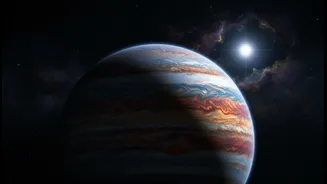
Webb's discoveries extend to our more immediate cosmic neighbours as well. In Saturn’s system, the moon Enceladus has long been a subject of fascination due to the water plumes erupting from its south pole. Webb’s incredible sensitivity allowed it to observe a water vapour plume stretching for more than 9,600 kilometres, an astonishing distance. These observations provide a direct look at how this tiny moon feeds water into Saturn’s entire ring system. Further in, at Jupiter, Webb has been studying the chaotic surface of the moon Europa. Its data suggests the icy shell is dynamic and porous, with ongoing cycling between the surface and the vast liquid ocean believed to lie beneath. Instruments detected carbon dioxide that likely originates from this subsurface ocean, which, given CO2's instability under the harsh radiation, means it must be a relatively recent deposit. These findings paint a picture of active, evolving worlds right in our backyard.
Looking at Worlds Beyond
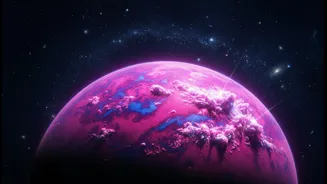
Beyond our solar system, Webb is providing the first real character studies of cold exoplanets. For planets that are too distant and faint for other telescopes, Webb’s infrared instruments can finally parse the light from their atmospheres. Take the so-called “Pink Planet,” GJ 504 b. For a decade, it was a mystery, but Webb recently detected its atmosphere is packed with water vapour, methane, carbon dioxide, and, most surprisingly, clouds made of salt. On another world, Epsilon Indi Ab, just 12 light-years away, Webb found evidence for thick water-ice clouds, similar to the cirrus clouds on Earth. This was deduced not by seeing the clouds, but by noticing the surprising lack of ammonia in the atmosphere—its chemical signature was being muffled by a high-altitude cloud deck. Each observation is like a weather report from another world, turning abstract data points into tangible atmospheric phenomena.
The Power of Infrared Vision
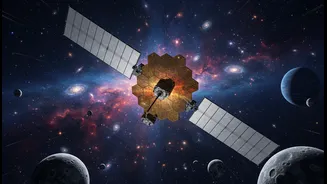
How does Webb achieve all this? The secret is its ability to see the universe in infrared light. This part of the spectrum is invisible to the human eye but is crucial for astronomy. Cold objects, like dwarf planets and distant exoplanets, radiate most of their faint energy as infrared heat. Furthermore, Webb’s instruments can act like chemical fingerprint readers. When light passes through an atmosphere or reflects off a surface, different molecules absorb specific wavelengths of light. By analyzing the resulting spectrum—the pattern of light that’s missing—scientists can identify the presence of methane, water, carbon dioxide, and other compounds. This technique, called spectroscopy, allows Webb to analyze the deuterium-to-hydrogen ratio in methane on Eris, suggesting it was made geologically, and to spot the chemical markers of clouds on worlds light-years away.