







Meet Asteroid 1998 KY26
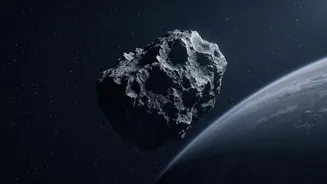
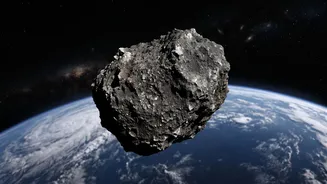
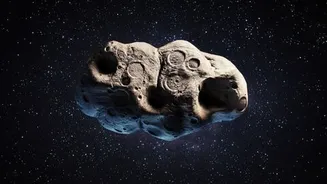
First, let’s get acquainted with the object at the heart of this cosmic puzzle. Discovered in 1998, 1998 KY26 is a minuscule asteroid, measuring only about 11 metres in diameter—roughly the size of a small bus. What makes it truly remarkable is its rotation.
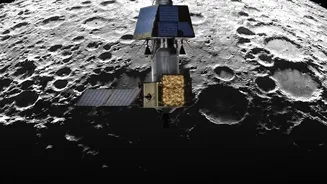
It spins incredibly fast, completing a full turn in just over five minutes. This object is more than just a curiosity; it is the target for an extended mission by the Japan Aerospace Exploration Agency's (JAXA) Hayabusa2 spacecraft, which is scheduled to rendezvous with it in July 2031. This will be the first time a mission has visited such a small, rapidly rotating asteroid, offering an unprecedented look at this class of celestial bodies.
The 'Dark Comet' Hypothesis
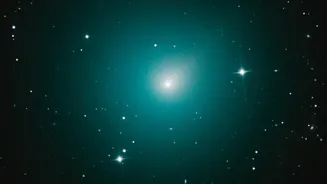
So, what is a dark comet, and why was 1998 KY26 a candidate? The line between asteroids and comets has blurred in recent years. Generally, asteroids are rocky bodies, while comets are 'dirty snowballs' of ice, rock, and dust. When a comet nears the sun, its ice sublimates—turns directly into gas—creating a visible coma (a fuzzy atmosphere) and tail. A 'dark' or 'dormant' comet is an old comet that has lost most of its surface ice after many trips around the sun. It no longer produces a visible tail but may still have buried ice that releases gas invisibly. This outgassing can give the object a tiny, non-gravitational push, altering its orbit in a way that can’t be explained by gravity alone. Because 1998 KY26 showed this kind of unusual acceleration, some scientists proposed it might be a dark comet.
New Research Casts Doubt
The headline-making 'fresh doubts' come from a new study by aerospace engineers at the Georgia Institute of Technology. They created a detailed thermal model of 1998 KY26 to see if it could possibly retain the buried water ice needed for outgassing. Their findings suggest it is simply too warm. The model calculated that the average temperature on the asteroid, even in its coldest regions, is around -61 degrees Celsius. While that sounds frigid, it’s significantly above the -128 degrees Celsius threshold needed for buried water ice to remain stable over long periods. At the temperatures calculated for 1998 KY26, any significant amount of water ice would have sublimated and vanished in just a few thousand years—or in as little as 62 years if it were responsible for the observed acceleration. This makes the dark comet theory a very unlikely explanation.
If Not a Comet, Then What?
If outgassing from hidden ice isn't pushing 1998 KY26, what is? The most likely alternative explanation is a phenomenon known as the Yarkovsky effect. This occurs when an asteroid absorbs sunlight and re_radiates that energy as heat. This emission isn't perfectly uniform and acts like a minuscule thruster, gently altering the asteroid's orbit over millennia. A 2025 reanalysis using updated physical properties of the asteroid showed that its non_gravitational acceleration can be fully explained by the Yarkovsky effect, lending strong support to this theory. As for its origin, recent observations suggest 1998 KY26 is a bright, solid chunk of rock, possibly an E_type asteroid. It may be a fragment that broke off a much larger parent body in a past collision. There is even a fringe, unconfirmed proposal that it could be the lost Soviet spacecraft Phobos 1, due to similarities in size and reflectivity.