




A Cosmic Nursery's Secret
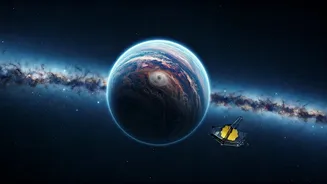
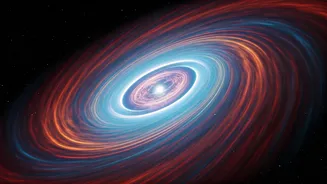
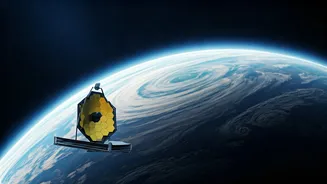
Astronomers using the powerful James Webb Space Telescope (JWST) have detected significant quantities of water vapour deep in space. The discovery was made in the inner region of a protoplanetary disk—a swirling ring of gas and dust where new planets
are born—surrounding a young star named PDS 70, located approximately 370 light-years from Earth. This isn't just any disk; it's a known planet factory, already hosting two gas-giant planets. The water was found in the terrestrial zone, the very region where rocky, Earth-like planets are expected to form. This is the first time water has been confirmed in the planet-forming region of a disk that is already known to be assembling a planetary system.
How They Found It
Detecting water from such a vast distance is a monumental feat of engineering and science. The discovery was made possible by JWST's Mid-Infrared Instrument (MIRI), which can analyse the chemical composition of distant cosmic objects. As light from the PDS 70 star passes through the disk, the water molecules absorb specific wavelengths of infrared light, leaving a unique chemical fingerprint. MIRI is sensitive enough to spot this signature, allowing scientists to confirm the presence of water vapour at a scorching temperature of around 330 degrees Celsius. Before the Webb telescope, instruments were not powerful enough to make this kind of measurement in the dense, inner regions of a planet-forming disk.
From Vapour to Worlds
For decades, a key debate among scientists has been how Earth got its water. One popular theory is that it was delivered late in our planet's formation by impacts from icy comets and asteroids. However, this new discovery lends significant weight to an alternative idea: that water is a fundamental ingredient available from the very beginning of a rocky planet's life. By finding water vapour and silicate dust—the raw material for rocky worlds—in the same place at the same time, scientists now have evidence that future planets forming around PDS 70 could be born with their own water reservoirs. This suggests that planets may not need to wait for a lucky cosmic delivery to become water worlds; the ingredients for oceans could be locally sourced from day one.
The Blueprint for an Alien Ocean
The term 'alien ocean' conjures images of vast liquid seas on distant exoplanets, and this discovery is a critical step in making that vision a reality. While the JWST detected water in its gaseous form (vapour) due to the high temperatures close to the star, this vapour is the source material for the water that will eventually be incorporated into the planets themselves. As a rocky planet forms and cools, this water can condense to form liquid oceans on its surface, provided the planet ends up in the star's 'habitable zone'—the orbital region where temperatures are just right for liquid water to exist. The finding at PDS 70 is so exciting because it shows a substantial water reservoir is present exactly where it's needed to seed future habitable worlds. This implies that the process that gave Earth its oceans might not be unique, but a common feature of planet formation across the galaxy.
The Search Continues
One of the remaining puzzles is how this water survives so close to the young star. The intense stellar radiation should, in theory, break the water molecules apart. Scientists theorise that the dense clouds of dust in the disk act as a protective shield, preserving the water from destruction. The next steps for researchers will be to use other JWST instruments to study the PDS 70 system in even greater detail. They also plan to observe other protoplanetary disks to determine if PDS 70 is an outlier or if water is a common ingredient in stellar nurseries everywhere. Each new detection will add another piece to the puzzle of how habitable planets—and potentially life—come to be.