








Our Modern World, Held Up by Satellites
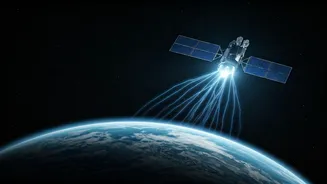
Think about your day. Did you use a map on your phone, check a weather forecast, or make a bank transaction? If so, you relied on space. Modern life is built on a fragile scaffolding of satellites orbiting Earth. [15] They provide the Global Positioning
System (GPS) for navigation, synchronise financial markets, enable global communications, and give militaries an unparalleled view of the planet. [13, 17] This deep dependency, however, has created a critical vulnerability. For a rival power, attacking a nation's capabilities on Earth is difficult. But disrupting the satellites that an entire economy and military rely on? That has become a dangerously attractive strategy. [13, 26] Space is no longer just an asset; it is the strategic high ground of the 21st century.
The New Arms Race Above the Clouds
The 1967 Outer Space Treaty forbids placing weapons of mass destruction in orbit, but it leaves a massive loophole for conventional weapons, which nations are now exploiting. [10] The United States, China, and Russia are openly developing and testing a new generation of anti-satellite (ASAT) weapons. [9, 21, 22] These aren't just science fiction concepts. They include “direct-ascent” missiles that physically smash into a satellite, ground-based lasers that can blind sensors, and electronic warfare systems that jam or even hijack signals. [13, 17] More insidiously, nations are testing “co-orbital” satellites that can sneak up on a rival's asset, potentially interfering with it or disabling it on command. Russia, China, the U.S., and India have all demonstrated the ability to destroy their own satellites, creating hazardous clouds of space debris in the process. [16, 24] This new arms race is less about visible explosions and more about achieving the ability to turn off an adversary's eyes and ears at a moment's notice.
The Key Players and Their Strategies
Three main rivals dominate this new battleground. The United States, with the creation of its Space Force in 2019, formally recognized space as a warfighting domain. [17] Its strategy relies on an integrated model, combining military, commercial, and allied capabilities to build resilience. [15] China is the “pacing challenge,” rapidly building a vast space infrastructure to bolster the People's Liberation Army and challenge U.S. dominance, from surveillance satellites to its own space station. [22, 23] Russia, meanwhile, leverages its legacy expertise while focusing on “denial” capabilities—weapons and tactics, including a reported nuclear anti-satellite device, designed to neutralize the advantages of its technologically superior rivals. [9, 12, 15] Other nations like India have also proven ASAT capabilities, turning space into an increasingly crowded and contested arena. [16, 21]
Beyond Orbit: The Cislunar Frontier
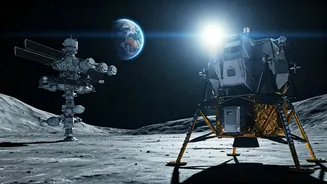
The competition isn't just confined to Earth's orbit. The next strategic prize is cislunar space—the vast region between the Earth and the Moon. [15, 18] This area, including the lunar surface itself, is rich with potential resources and strategically vital locations called Lagrange Points, where the gravity of the Earth and Moon balance out. [20, 25] An object placed at a Lagrange Point can remain stable with minimal fuel, making these spots ideal for long-term surveillance, communications relays, or even staging areas for deeper space missions. [15, 25] The new race to the Moon, led by the U.S.-helmed Artemis program and a rival China-Russia initiative, is not just for scientific prestige. [8, 9] It is about establishing the infrastructure and staking claims in what is becoming the next great theatre of geopolitical competition.
The Wild Card: Private Companies
A new factor is complicating this state-led rivalry: the rise of commercial space giants. Companies like SpaceX, Blue Origin, and others have revolutionized access to space, drastically reducing launch costs. [5, 7] This has democratized space, but also blurred the lines between civilian and military activity. A company like SpaceX now operates a huge portion of the world's active satellites and provides critical launch services for the U.S. government. [4] While this adds to national capabilities, it also means commercial assets like Starlink's satellite internet constellation could become legitimate targets in a conflict, creating complex legal and ethical dilemmas. [5, 14] The involvement of profit-driven enterprises adds a volatile and unpredictable element to an already tense environment.