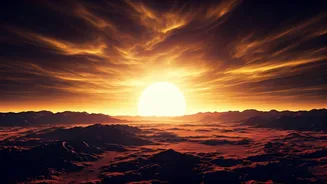




Putting the 'Solar' in Solar System
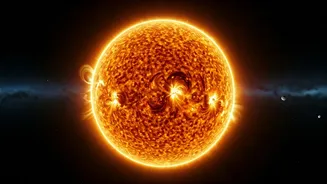
When we say the Sun dominates the solar system, it’s not an exaggeration. The most precise measurements show that our star accounts for a staggering 99.86% of the total mass of the entire system. [1, 6] Everything else—all eight planets, their dozens
of moons, and all the asteroids, comets, and dust—makes up the leftover 0.14%. [6] To put that in perspective, the Sun's mass is about 333,000 times that of Earth. [5] One astronomer memorably described the solar system as "the Sun plus some debris," which perfectly captures the scale of this disparity. [8] This overwhelming concentration of matter in one central object is the result of our solar system's formation around 4.6 billion years ago, when a giant cloud of gas and dust collapsed under its own gravity, with the vast majority of material being pulled to the center to form the Sun. [3]
What About Jupiter?
But surely Jupiter, the king of the planets, makes a dent? While Jupiter is enormous by planetary standards—more massive than all the other planets combined—it is still just a tiny fraction of the whole. The gas giant accounts for only about 0.1% of the solar system's total mass. [6] When you combine Jupiter with the second-largest planet, Saturn, you've accounted for more than 90% of the *non-solar* mass. [11] Yet, even these two giants are trivial compared to the Sun. In fact, the Sun is about 1,000 times more massive than Jupiter. [7] This comparison highlights the true scale of the Sun's dominance; even the most massive planet in our system is barely a blip on the cosmic mass scale.
The Dictatorship of Gravity
This extreme mass imbalance has one primary consequence: gravity. As Isaac Newton first formalized, the force of gravity between two objects is proportional to their mass. [17] Because the Sun is so colossally massive, it exerts an immense gravitational pull that everything else is forced to obey. This gravity is what holds the entire solar system together, from the closest planets to the distant debris in the Oort Cloud. [17, 19] It dictates the orbits of every planet, asteroid, and comet, acting as an invisible tether that prevents them from flying off into interstellar space. [17] The planets are in a constant state of falling toward the Sun, but their sideways motion is fast enough that they perpetually miss, resulting in a stable orbit. Without the Sun’s gravitational dictatorship, the orderly system we know would not exist.
Mass as an Engine
The Sun's mass is not just about gravitational control; it is the very engine of its existence. The immense weight of the star's outer layers creates unimaginable pressure and temperatures in its core—reaching about 15 million degrees Celsius. [18] These extreme conditions are what enable nuclear fusion, the process where hydrogen atoms are smashed together to form helium. [18] This reaction releases a tremendous amount of energy, which pushes outward, counteracting the inward pull of gravity and keeping the star stable. [18] This energy, radiated as light and heat, is what powers our planet, drives our weather, and makes life on Earth possible. [1, 19] Every second, the Sun converts about 600 million tons of hydrogen into helium, with about 4 million tons of that matter being converted directly into energy. [5]