


An Invisible Storm
Beyond the protective bubble of Earth’s magnetic field and atmosphere, space is not empty. It is flooded with a continuous shower of high-energy particles. This space radiation comes from two main sources: a steady, low-level stream of galactic cosmic
rays (GCRs) from distant supernovae, and sudden, intense bursts of solar energetic particles (SEPs) from storms on our own sun. While SEPs are powerful, they are sporadic and can often be shielded against. The more formidable challenge for a long-duration mission to Mars is the relentless barrage of GCRs. These are atomic nuclei—ranging from hydrogen to iron—stripped of their electrons and accelerated to nearly the speed of light, allowing them to pierce through most standard shielding materials like aluminum.
The High Cost for Humans
For the fragile human body, the journey to Mars is a trip through a shooting gallery. A round trip could expose an astronaut to a dose of over 600 millisieverts of radiation—equivalent to getting a full-body CT scan every five or six days. This dose alone would account for more than half of the career limit for astronauts. The health consequences are severe. This constant bombardment of particles damages DNA and cells, significantly increasing the lifetime risk of cancer. Beyond cancer, there are risks of degenerative diseases affecting the heart and central nervous system, potentially leading to cognitive impairment, memory loss, and even accelerated aging. Shielding humans is a monumental task. Simply adding thick layers of passive materials like aluminum is prohibitively heavy and expensive for a Mars mission. Worse, when high-energy GCRs strike these materials, they can create a secondary spray of even more particles, potentially making the problem worse inside the spacecraft.
Resilience in Robots
Robots are not alive, but they are not immune to radiation's effects. Instead of damaging cells, high-energy particles wreak havoc on sensitive electronics. A single particle can flip a bit in a computer's memory, causing a 'single-event upset' (SEU) that can lead to data corruption or a system crash. More intense radiation can cause permanent damage or total failure. To counter this, engineers use a strategy called 'radiation hardening'. This can involve using specific materials for shielding sensitive components, designing circuits with built-in error correction, or using redundant systems that can take over if one fails. While this adds to the cost and complexity of robotic missions, the challenge is fundamentally different. Protecting a few critical microcontrollers is a more targeted and achievable engineering problem than shielding an entire human habitat. This makes robotic exploration vastly cheaper and less risky from a hardware perspective.
A Tale of Two Shielding Strategies
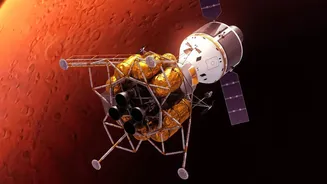
The different vulnerabilities of humans and robots lead to divergent technological paths. For human missions, the focus is on creating a safe haven. This includes investigating novel passive shielding materials like hydrogen-rich plastics or even water, which are better at stopping GCRs without creating as much secondary radiation. More advanced concepts include 'active shielding', which would use powerful magnetic or electric fields to deflect incoming particles, mimicking Earth's magnetosphere. These technologies, however, are still in early development. For robotic missions, the strategy is one of resilience and targeted protection. Instead of shielding the whole spacecraft, engineers focus on making the 'brains' of the robot tough enough to withstand the environment. Companies are developing increasingly cost-effective 'radiation-tolerant' components that offer significant protection without the extreme cost of full military-grade hardening, making long-duration robotic missions more feasible.
Pioneers and Probes
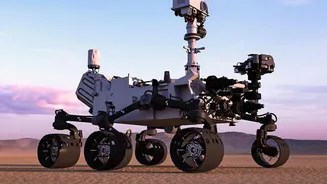
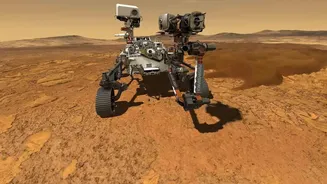
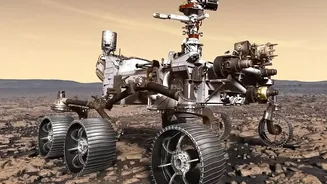
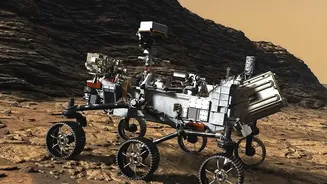
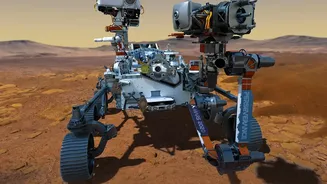
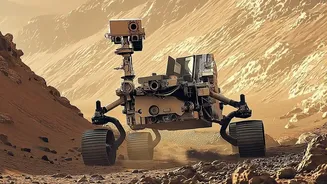
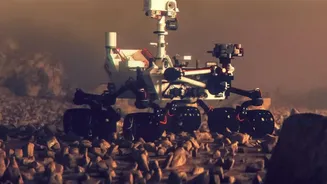
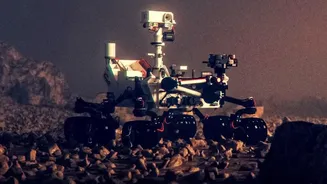
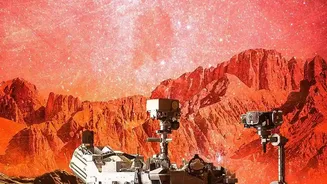
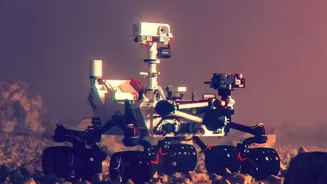
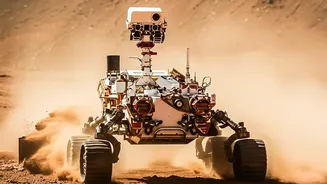
The stark contrast in how radiation affects humans versus robots defines the current era of Mars exploration. Robotic missions like the Perseverance rover are our scouts, able to operate for years in a hostile environment that would be incredibly dangerous for a person. They perform invaluable science and reconnaissance at a fraction of the cost—a single human mission to Mars is estimated to be as expensive as a hundred robotic ones. However, robots are slow and limited in their ability to adapt and problem-solve. A human geologist on Mars could accomplish in minutes what might take a rover weeks. This is the trade-off at the heart of the debate: the efficiency and safety of robots versus the adaptability and ultimate purpose of sending humans.