




For years, a strange cosmic puzzle has captivated astronomers: a mysterious gap in the sizes of planets found outside our solar system. Now, a fresh look at the light from distant stars is finally shedding light on why these 'missing' worlds are so rare.
The Puzzle of the 'Radius Valley'
Since the hunt for exoplanets began, we have found thousands of worlds orbiting other stars. These discoveries revealed a curious pattern. Astronomers found plenty of rocky planets up to about 1.5 times the size of Earth, known as 'Super-Earths'. They also found many gas-enveloped planets larger than two times Earth's radius, called 'mini-Neptunes'. But in between those sizes, there's a significant drop-off in numbers. This phenomenon became known as the 'radius valley' or the 'Fulton Gap'. It was as if nature was hesitant to build planets in that specific size range, and for a long time, scientists weren't sure why.
Two Competing Theories Emerge
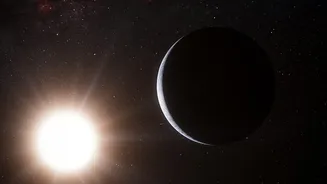
Two main ideas emerged to explain the radius valley. The first is called 'photoevaporation'. This theory suggests that planets in the valley are born as slightly larger 'mini-Neptunes' with thick, puffy atmospheres of hydrogen and helium. However, because they orbit close to their star, intense radiation blasts away this atmosphere over the first 100 million years or so, shrinking the planet down to its dense, rocky core. The second theory is 'core-powered mass loss'. This model proposes that the heat radiating from a planet's own molten core provides the energy to push its own atmosphere away over a much longer timescale, perhaps a billion years. Both theories could potentially explain the gap, but proving which one was dominant was a major challenge.
A Fresh Look at the Host Stars
The breakthrough came when astronomers shifted their focus. Instead of just looking at the planets, they took a 'fresh look' at the host stars themselves. Starlight holds a wealth of information. By carefully analysing a star’s light—a technique called spectroscopy—scientists can determine not just its temperature and size, but also its age and chemical composition. The idea was that if the radius valley was shaped by a process that takes time, like photoevaporation or core-powered mass loss, then the age of the planetary system should hold the key. A star's light acts like a cosmic clock, allowing astronomers to date the entire system and see how planets have evolved.
What the Starlight Revealed
Recent studies using this stellar-focused approach found that the location and depth of the radius valley change depending on the mass and age of the host star. For example, around smaller, cooler M_dwarf stars, the valley seems to disappear altogether, suggesting planet formation works differently there. Furthermore, by looking at star clusters of different ages, astronomers could test the timelines of the two theories. They found that the number of smaller, rocky 'Super_Earths' increases in older systems, while the number of larger 'mini_Neptunes' decreases. This observation strongly suggests that many planets start out larger and are then stripped of their atmospheres over time.
The Missing Planet Mystery Solved
The new evidence points towards a combined solution, but with one theory playing the lead role. Photoevaporation, driven by the intense radiation from a young host star, appears to be the primary sculptor of the radius valley, especially in the early life of a planetary system. It acts quickly and forcefully to strip the atmospheres from planets that are not massive enough to hold on. Core_powered mass loss also contributes, but it is a slower, secondary process that continues to shape planets over billions of years. Essentially, the powerful light from a star is the main reason why we see so few planets in that intermediate size range. They are either born large and stay large, or they are born in the 'danger zone' and are shrunk by their own sun.