




The Twinkle Test: A Star's Giveaway
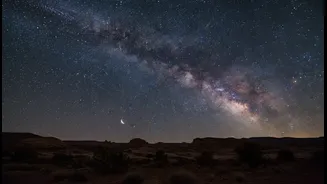
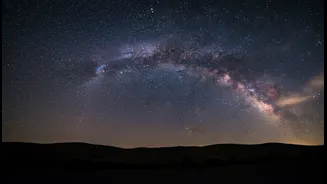
The first step is to figure out if you're even looking at a planet. The easiest way to tell a planet from a distant star is the famous “twinkle test.” Stars, being incredibly far away, appear as single points of light. As their light travels through the Earth's
turbulent atmosphere, it gets bent and distorted, causing the flickering effect we call twinkling. Planets in our solar system, however, are much closer. To our eyes, they aren't just points but tiny discs. While their light is also affected by the atmosphere, the light from the whole disc averages out, resulting in a steady, unwavering glow. So, if the object is twinkling, it's a star. If it shines with a solid, consistent light, it could be a planet—or something else.
Motion Is the Ultimate Clue
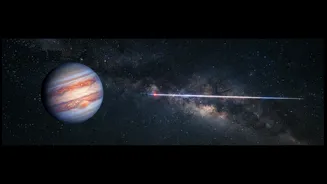
This is the most definitive way to distinguish a planet from an airplane. Observe the bright object for about 30 seconds to a minute. An airplane, even one that appears to be hovering as it approaches from a distance, will show clear movement against the backdrop of stars. It will visibly change its position, often moving quite rapidly across your field of view. A planet, on the other hand, will appear perfectly stationary in the short term. While planets do move along a set path, this motion is only perceptible over many hours or from night to night. If it's cruising across the sky, you're looking at a flight, not Jupiter.
Flashing Lights vs. a Steady Glow
Commercial aircraft are required to have specific navigation and anti-collision lights. These are the biggest giveaway. Look closely at the object. Do you see blinking, flashing, or strobing lights? Airplanes typically have a red light on their left wingtip, a green one on the right, and white flashing strobes. Even from far away, you will notice a rhythmic flashing or blinking pattern. Planets do not have blinking lights. They shine with a constant, uninterrupted glow. Their light is simply reflected sunlight. If the light is steady and not flashing, you can rule out an airplane. The same goes for satellites, which typically appear as steady, slow-moving points of light that don't blink.
Color, Brightness, and Context
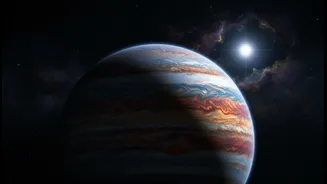
Planets often have a distinct colour and brightness. Venus, for instance, is exceptionally bright and a brilliant white, often called the “Evening Star” or “Morning Star” because it appears near sunrise or sunset. Mars is famous for its distinct reddish hue. Jupiter and Saturn often appear as bright, yellowish-white jewels. Airplanes have coloured lights, but the lights themselves are separate points and flash, whereas a planet is a single object with a consistent colour. Brightness is another clue. The brightest objects in the night sky, after the Sun and Moon, are usually Venus and Jupiter. They often outshine every star, which can make them seem unusual to a casual observer. If you see a surprisingly bright, non-twinkling 'star', you are almost certainly looking at a planet.
Location, Location, Location
For a more advanced trick, know that planets follow a celestial highway. The Sun, Moon, and all the planets travel along a specific path in the sky called the ecliptic plane. Think of it as the flat plane of our solar system projected onto the sky. You will never find a planet in a random part of the sky, like way up in the north. They always stick to this path, which is also where the constellations of the zodiac are found. If the object you are watching is far from this imaginary line, it's unlikely to be a planet. While you don't need to know the exact path, just knowing that planets follow a predictable route can help you confirm your suspicions.